The Art of Noticing & Individualizing: Secrets from Stage Managers
Welcome back to the Unschooling Mom2Mom Podcast!
Today we’re talking about something that makes unschooling truly unique—real individualization.
If you’ve ever had kids in school or followed a traditional homeschool approach, you’ve probably heard the phrase individualized learning thrown around. Schools claim to offer it. Homeschool curriculums promise it.
But most of the time? It’s just a fancy way of saying,
"We’ll let kids go a little faster or slower, but they’re still on the same predetermined track."
That’s not real individualization. That’s lip service.
Unschooling? It fully embraces the idea.
Before we dive in, be sure to click the subscribe button if you’re at YouTube, or any of the other platforms you’re using. This helps the Unschooling Mom2Mom podcast reach more parents who are struggling. It can be your little part to help spread the word! I’m here every week, creating these 10 minute peptalks to help you on your unschooling journey.
My own three kids are grown now, and I’ve seen what worked and what didn’t. People helped me figure this out - and so that’s what I want to do too - for you! Unschooling really does work. And I have so many resources for you to tap into - it all depends on how WE learn best too - in community conversations, with courses or coaching, reading ebooks or guides, watching videos, listening to podcasts.
This is the start of Season 5 - and we have over 330K downloads. Just you and me chatting each week for 4 YEARS now. It’s been so fun - I hope you’re loving it as much as i do! I'd love to hear from you in the comments - I read every one of them!
And one thing we’re going to do differently with Season 5,
is I want to help those of you who are DIYing your way through this unschooling process.
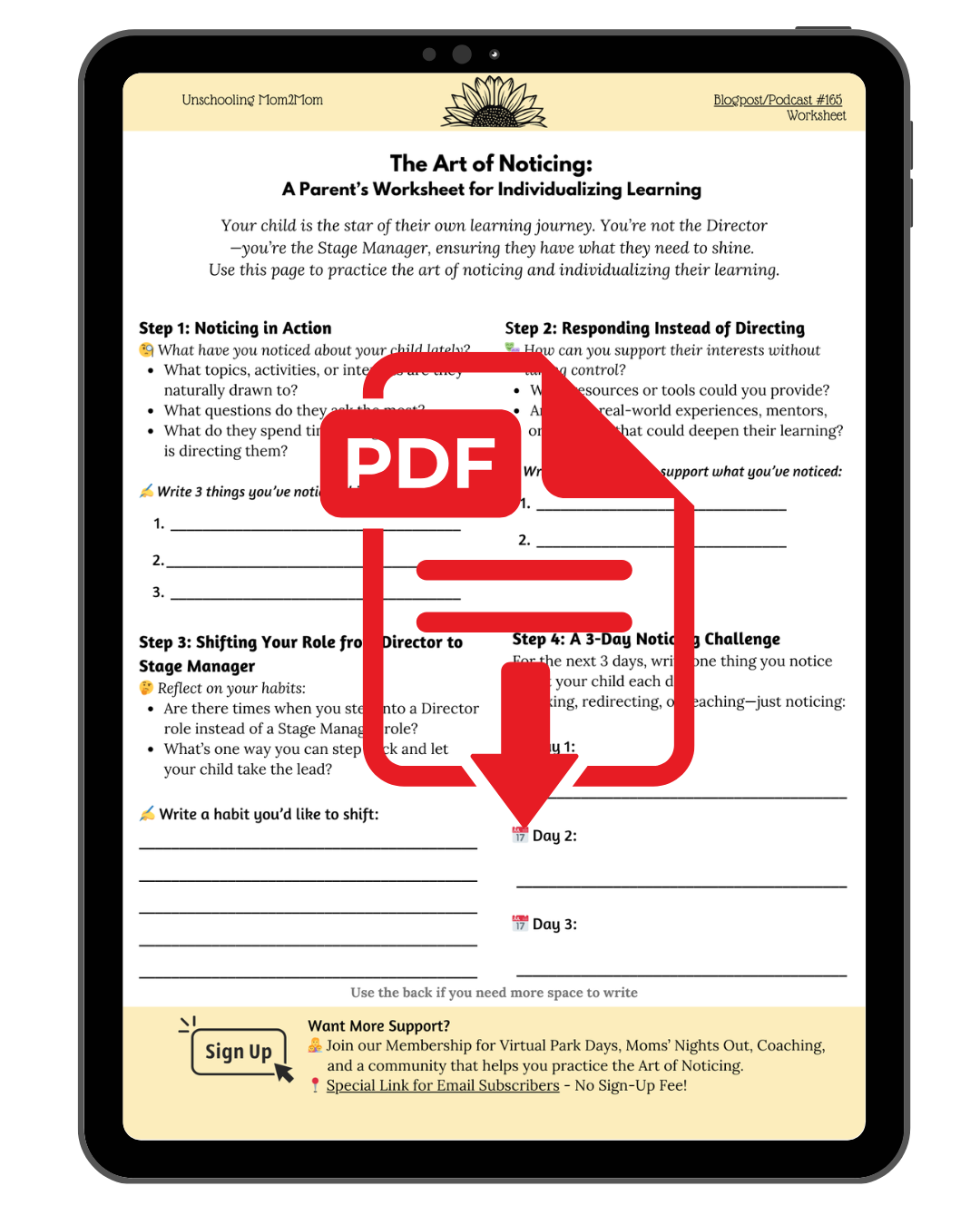
Wherever possible, I’m going to create a PDF that is SPECIFIC to the topics of the podcast.
I have one for you today! Right here!
OK, so back to this art of noticing and individualizing learning. This is what truly sets unschooling apart - this deep individualization.
Not the kind of learning where you tweak a curriculum here and there, but the kind where your child’s learning is entirely shaped by who they are, how they think, and what lights them up.
Because let’s be real—that’s not something a standardized curriculum can give you. It’s not something a school can provide, and honestly, it’s not something most traditional homeschooling methods achieve either. Because the heart of true individualization isn’t about picking the right program—it’s about tuning in to your child.
When kids are free to learn outside of standardized structures, they naturally move in the direction their brain wants to go. Science tells us that. Each brain is unique, each family is different.
And that’s the heart of unschooling.
Embracing this, is the real work for parents.
It’s not about guiding, instructing, or pushing. It’s shifting away from trying to control it all. It’s about becoming really good at something else:
noticing.
And...that changes everything.
Noticing vs. Directing
A lot of us were raised to believe that teaching means telling—directing, guiding, making sure our kids are always moving forward toward something. But what if that’s not actually how learning works best?
What if our job as unschooling parents isn’t to direct, but to notice?
👀 Noticing what excites our kids.
👀 Noticing what makes them pause and think.
👀 Noticing what they avoid—and why.
And when we get better at noticing, we realize that learning isn’t something we have to force.
It’s already happening. It’s already unfolding in front of us.
Instead of controlling and orchestrating, our job becomes more about slowing down and
tuning in.
It’s about being present, being aware, and understanding that the child standing in front of us is constantly giving us clues about what’s important to them.
And this is where one of my favorite metaphors for unschooling comes in...
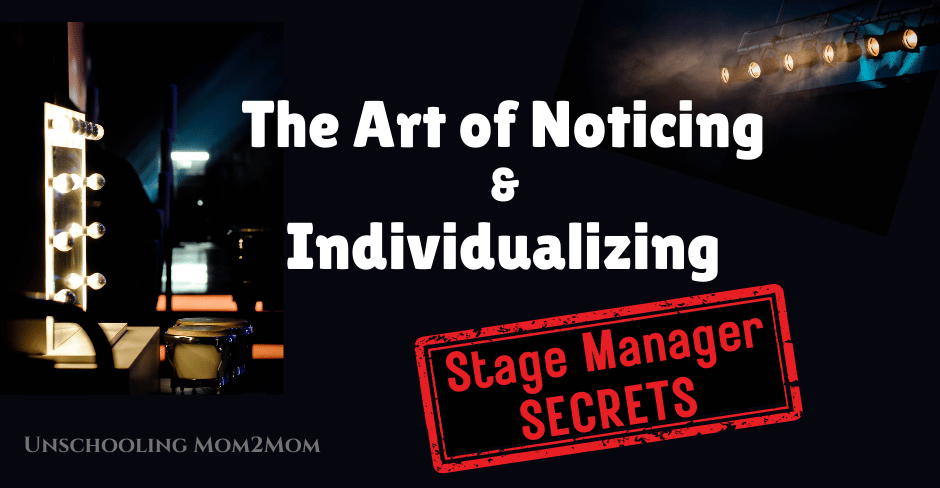
The Theatre!
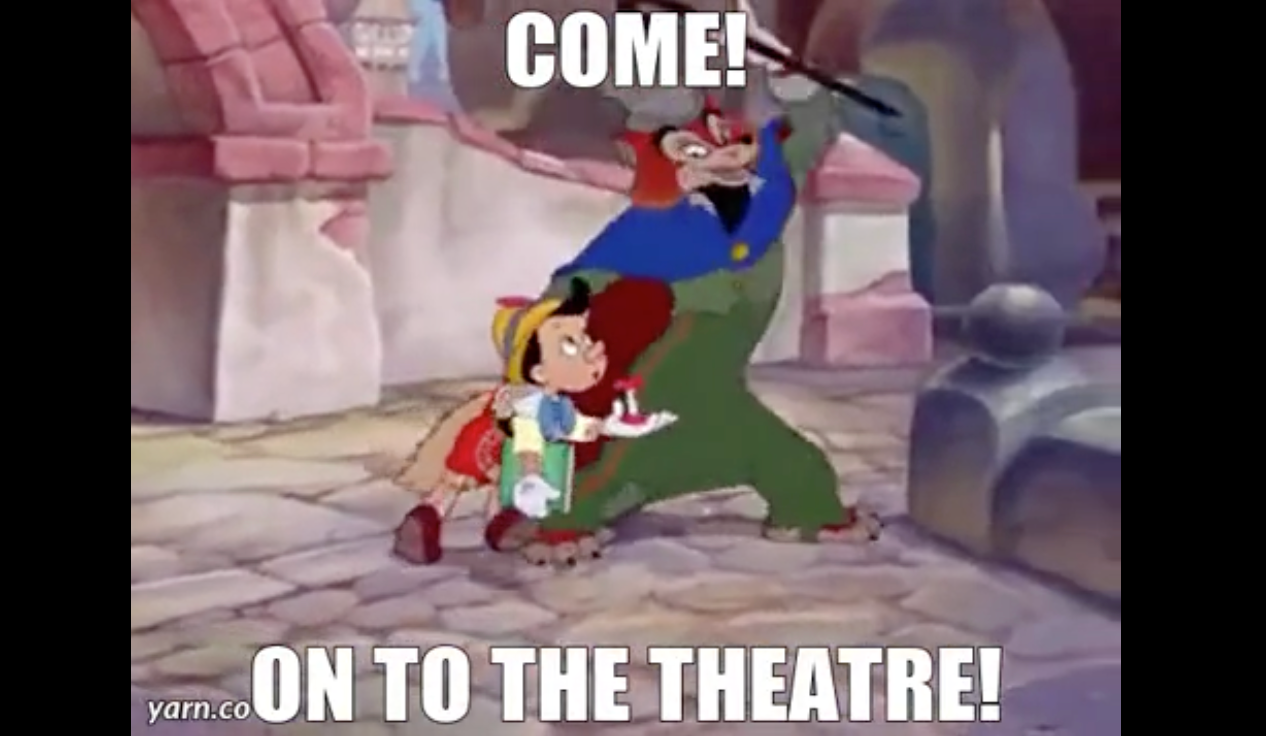
When my kids were little, they watched this version of Pinocchio so often,
that they'd refer to "The Theatre" in this same flamboyant tone!!
😂
What does Theatre have to do with Unschooling?
When my kids were younger, they were heavily involved in community theatre. And like any dedicated mom, I got involved too—running lights, working backstage, making sure the show went on without a hitch.
And when I look back, I see such a powerful connection between theatre and the way kids truly learn best through unschooling.
In school—or even in traditional homeschooling—parents and teachers often take on the role of
Director.
They decide what’s going to be learned, how it will be taught, and when the “performance” happens. They call the shots and expect the kids to follow along.
But here’s the thing—good directors don’t micromanage. They give actors room to explore, to find their own way of delivering a line, of stepping into their role. That’s when the real magic happens.
And in unschooling, guess what?
Your child is the star of the show.
They don’t want to be micromanaged either.
And your role?
You’re not the Director.
You’re the
Stage Manager.
A good Stage Manager isn’t the one dictating what happens. They’re the one who notices what’s needed before anyone else does. They set the stage, yes, and they’re also constantly observing, making adjustments, solving problems before they even arise.
They make sure the right props are in place.
They help with costume changes when needed.
They support the actors without stealing the spotlight.
And the best Stage Managers don’t just react to problems—they anticipate them. They notice when something is slightly off before it turns into a crisis. They see the little details others overlook.
And that’s exactly what unschooling parents learn to do:
- We notice when our kids are struggling—not so we can force them onto a new track, but so we can offer support if they need it.
- We notice when they’re lit up by something—not so we can turn it into a formal lesson, but so we can give them more opportunities to explore.
- We notice when their interests shift—not so we can redirect them, but so we can trust that their learning is naturally evolving.
The show runs so much more smoothly when we step into that role. Not as the Director. Not as the Lead. But as the one behind the scenes, paying attention, and being ready to support when needed.
Trusting the Brain’s Natural Learning Path
This is where deschooling comes in—because when parents first start unschooling, we don’t always trust that learning is happening. We’re so used to measuring and tracking, so used to thinking that progress has to be directed, that we don’t know how to just
let it be.
But once you’ve deschooled for a while?
You realize that
the learner is already moving in the direction their brain wants to go.
Not where a curriculum says they
should go.
Not where an adult
thinks they need to be.
But where their own natural curiosity and internal drive is leading them.
And when we step back and trust that?
Learning becomes deeper, and richer, and more meaningful than anything a pre-planned curriculum could offer.
This Shift Takes Time
Now, I want to be really clear—this isn’t something that happens overnight.
We’ve all been conditioned to believe that kids need to be
taught in order to learn.
That if we’re not directing, guiding, or pushing, they’ll just... stop.
But that’s simply not true.
Unschooling works best when parents learn to pay attention rather than take control.
And if you’re still in the process of shifting to that mindset, I have the link to a Free PDF to help you with this. Be sure to grab that while this is all fresh in your mind.
And if you learn better with other people around, we’ll be talking about this more in my membership group.
You don’t have to do any of this alone. Being part of a community of like-minded parents could make all the difference.
Join Us for More Support
We’ve just added
Virtual Park Days and
Moms’ Nights Out to the membership program - so you can connect with other unschooling families in real time.
Because having a place to ask questions, share wins, and see what’s possible makes this journey so much easier.
So if you’re ready to step into the role of Stage Manager—if you’re ready to trust, notice, and support rather than direct—come join us. We’d love to have you.
That’s all for today! Thanks for being here, and I’ll see you next time.