Radical Unschooling (And Why You Don’t Need to Be Afraid of It)

Radical unschooling is often misunderstood as extreme, hands-off parenting or a rejection of learning altogether.
In reality, radical unschooling is about going to the root of how children learn best — through connection, trust, and real life. It's not limited to academics - it's about ALL Learning.
This post explains what radical unschooling actually means, what it doesn’t, and why it’s far more intentional than most people assume.
Radical Unschooling: What It Really Means (and Why It’s Not Extreme)
“Radical unschooling” sounds scary to a lot of people.
That reaction makes sense. The word radical tends to conjure images of chaos, extremes, or an “anything goes” approach to parenting and learning. Add in the misunderstandings people already have about unschooling, and it’s easy to see why this term raises eyebrows.
But most of that fear comes from a misunderstanding — of the word radical, and of unschooling itself.
Let’s slow it down and look at what it actually means.
What People Think Radical Unschooling Means
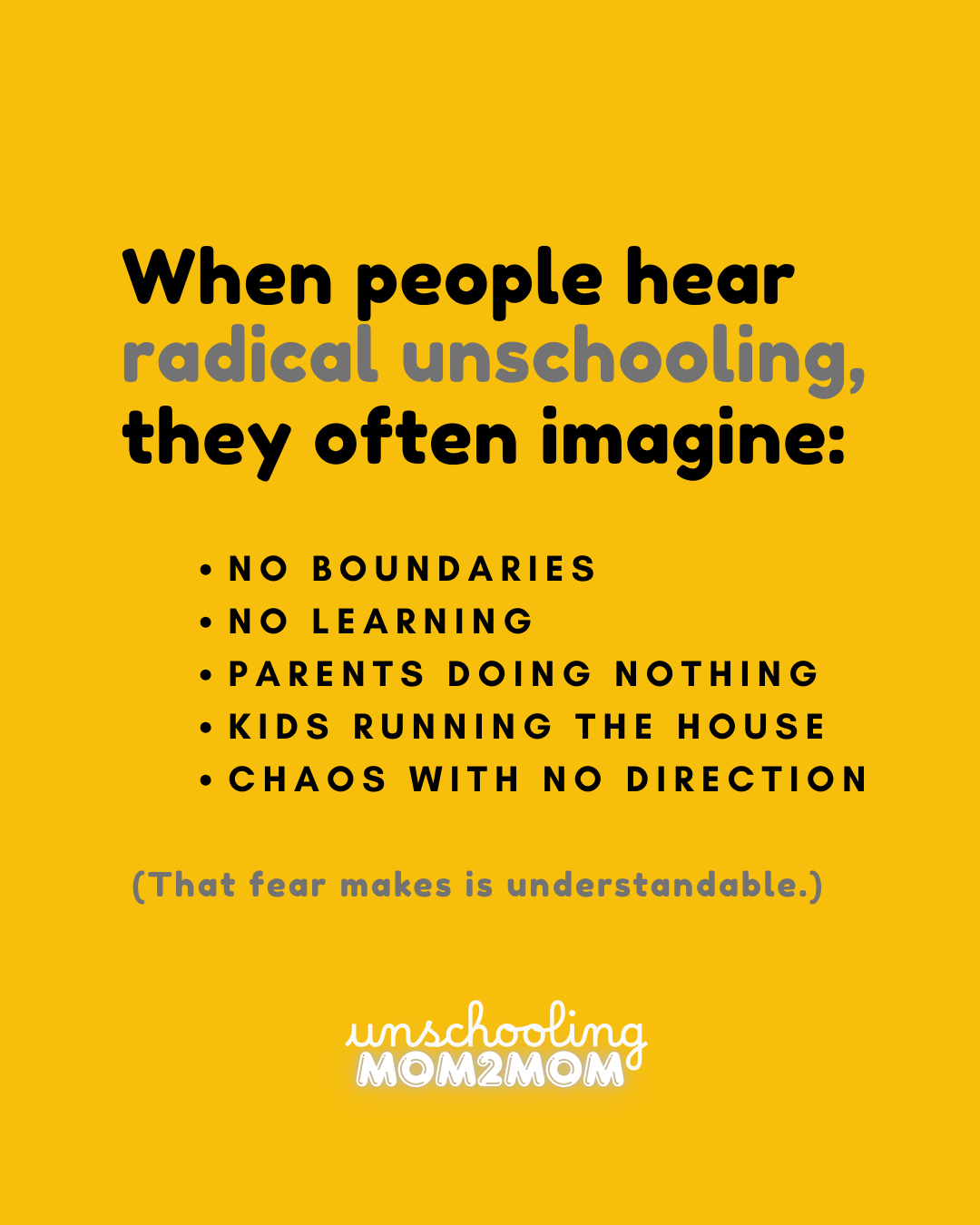
When people hear the phrase radical unschooling, they often picture things like:
- No boundaries
- No learning
- Parents doing nothing
- Kids running the house
- Chaos with no direction
That picture can feel unsettling, especially if you care deeply about your child’s well-being and future. And to be clear — that fear is understandable.
But that picture isn’t what radical unschooling actually is.
Not even close.
This is the image most people have in their heads — and it’s understandable.
Radical Unschooling
Does Not Mean Reckless Parenting
The word radical doesn’t mean wild or irresponsible.
It means going to the root.
Radical unschooling focuses on the root of learning, not just the surface behaviors we’ve been taught to monitor or control. Instead of asking, “Does this look like school?” the question becomes, “What supports real growth here?”
At the root, you’ll find things like:
- Curiosity
- Connection
- Trust
- Autonomy
- Relationship
These aren’t extreme ideas. They’re human ones.
The Core Values Behind Radical Unschooling
One of the biggest misconceptions is that unschooling — especially radical unschooling — removes important parental roles.
It doesn’t.
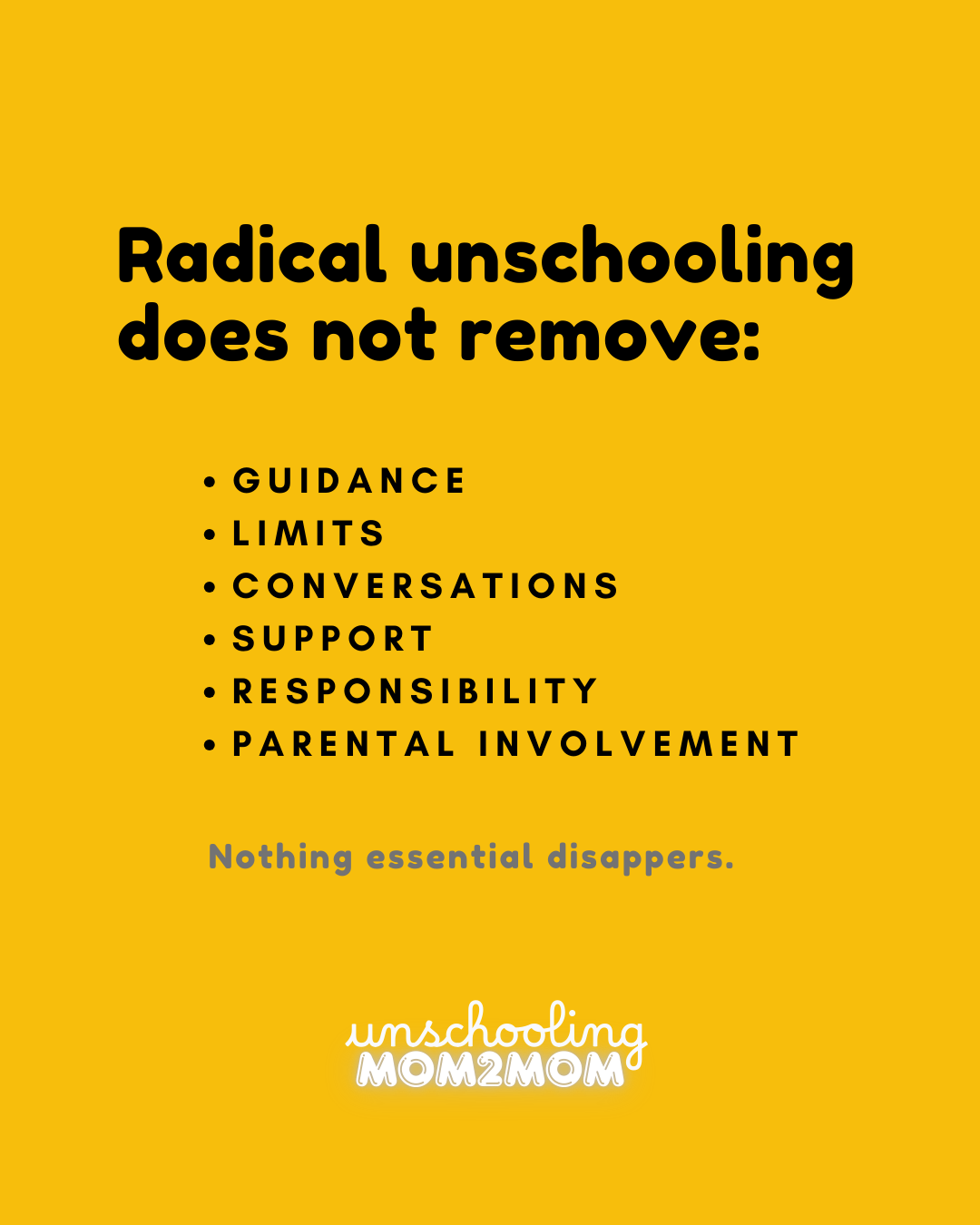
Radical unschooling does not remove:
- Guidance
- Limits
- Conversations
- Support
- Responsibility
- Parental involvement
Nothing essential disappears.
What does disappear is the idea that control, compliance, or constant oversight are the best tools we have.
What Unschooling Is — and Is Not
It may help to name this clearly.
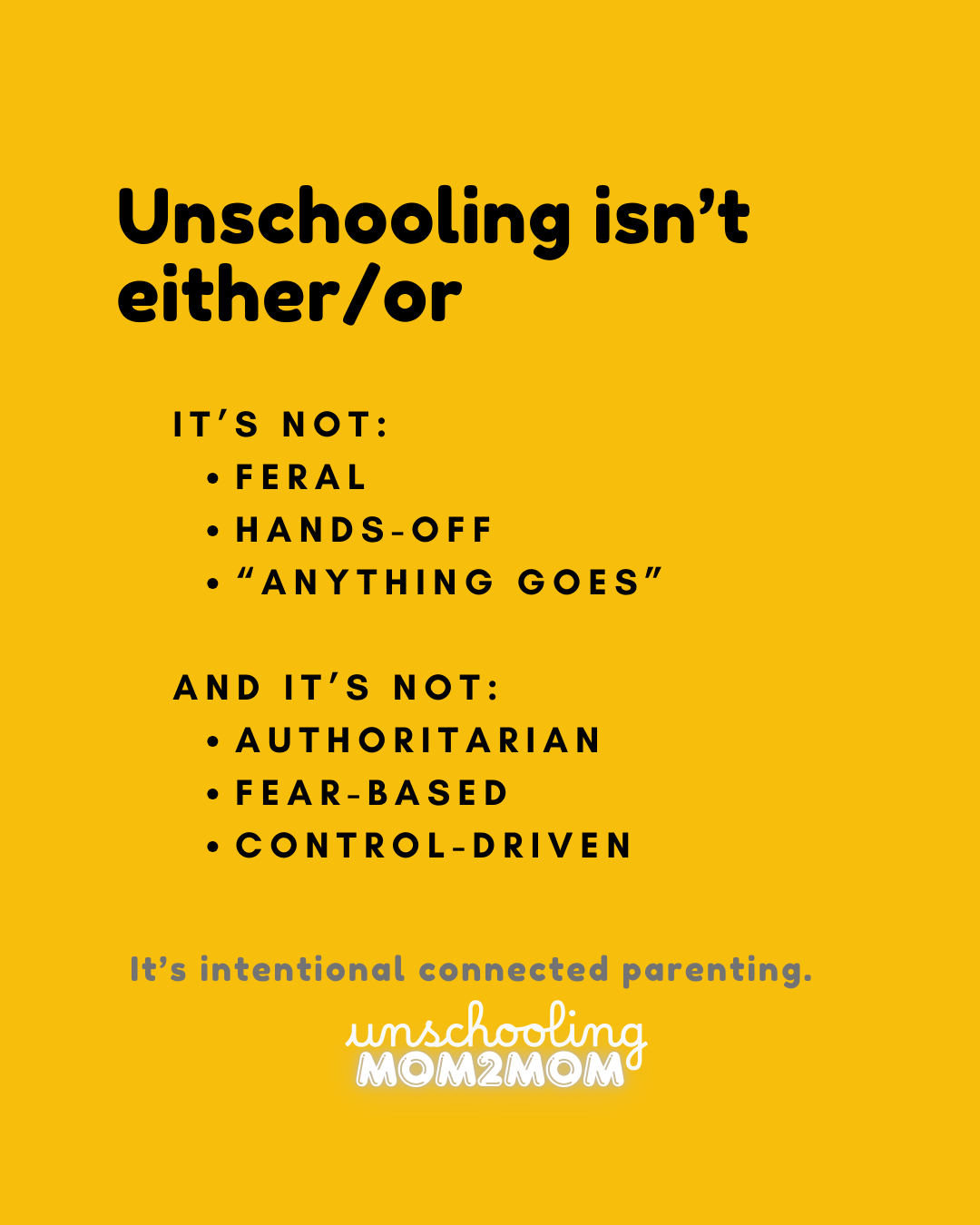
Unschooling is not:
- Feral
- Hands-off
- “Anything goes”
And it’s also not:
- Authoritarian
- Fear-based
- Control-driven
Radical unschooling is not a lack of parenting.
It’s intentional, engaged parenting — just guided by different priorities.
How Radical Unschooling
Changes the Focus of Learning
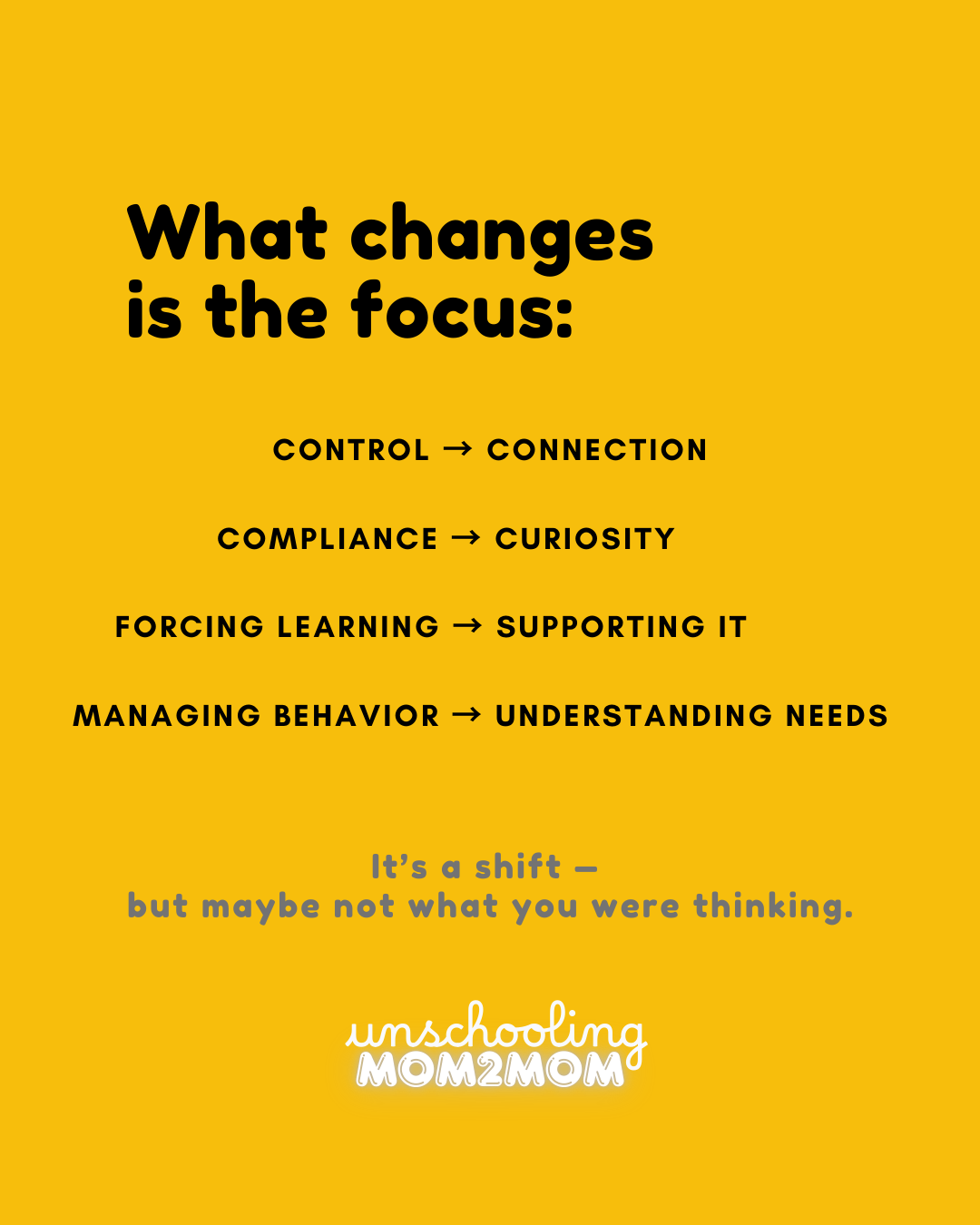
The real shift isn’t about doing less. It’s about focusing differently.
That shift often looks like:
Control → connection
Compliance → curiosity
Forcing learning → supporting it
Managing behavior → understanding needs
This can feel unfamiliar, especially if you were raised in systems that emphasized obedience, performance, or external validation.
But it’s a shift toward relationship, not away from responsibility.
Radical Unschooling
as Intentional, Relationship-Centered Parenting
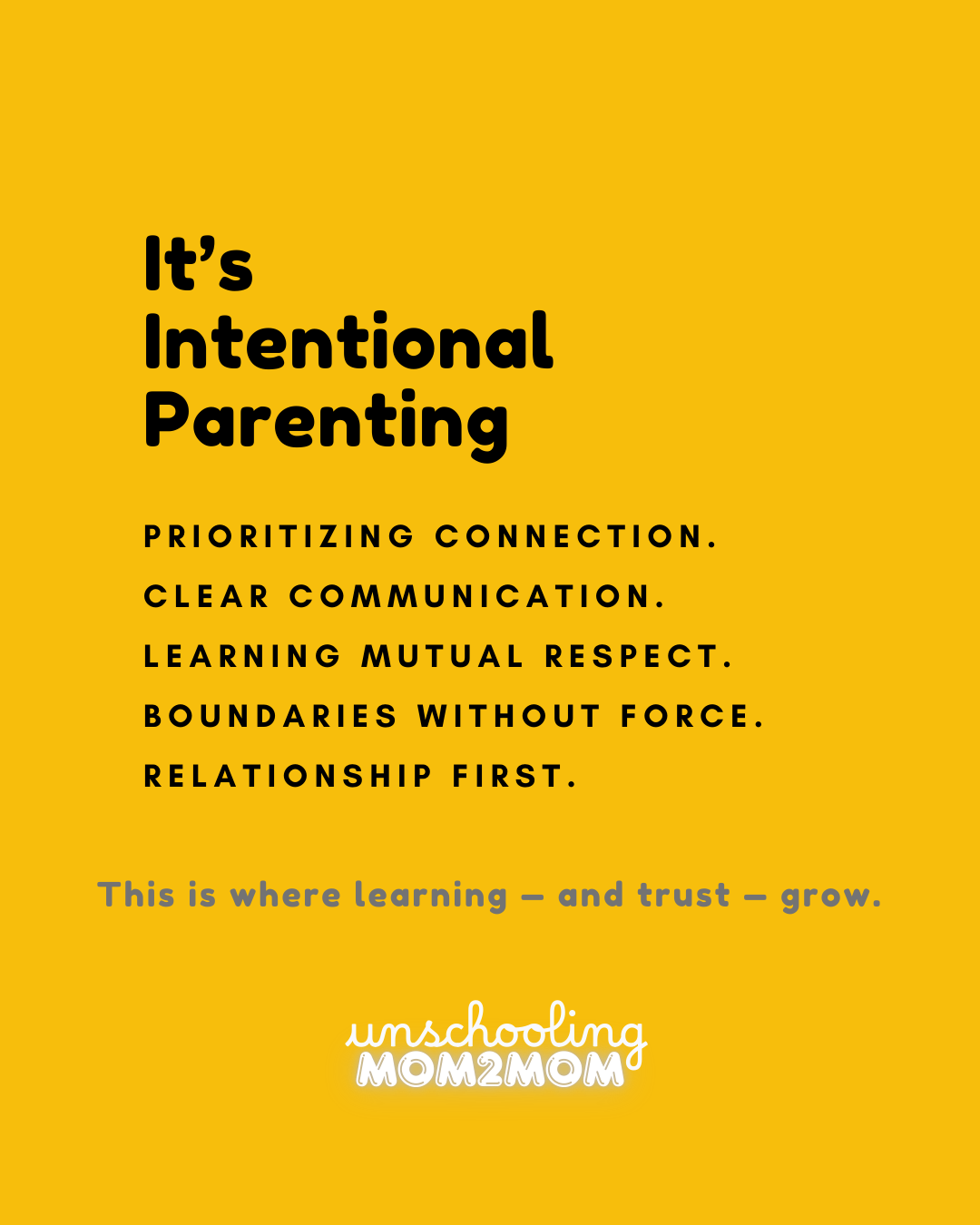
At its core, radical unschooling is about:
- Prioritizing connection
- Clear, respectful communication
- Learning mutual respect
- Holding boundaries without force
- Putting the relationship first
This is where learning — and trust — actually grow.
Radical Unschooling Is About Doing What Matters Most
Radical unschooling isn’t about stepping back because you don’t care.
It’s about stepping in with clarity, presence, and intention.
Nothing about caring deeply for your child is extreme.
If the term radical unschooling has made you uneasy, that’s okay. The label isn’t important.
Learning better ways to support our kids is what actually matters.
"I like this, but how do I shift my own mindset about it?"
Glad you asked! You do it with others who are doing the same thing.
We talk about these kinds of things n my membership group. You need support, brainstorming, space, to figure out what will work at your house with YOUR family. I can help you without a dogmatic way of approaching unschooling.
We all embrace some parts before others — that's how we learn to individualize in ways that will really work.
Test the waters! 7 day Free Trial.
Encouraging voice notes, tips, and inspiration to help keep you moving in the unschooling direction.
Tired of figuring this out alone?
Sue and her private community of unschooling parents can help you feel more confident and less isolated!
Frequently Asked Questions About Radical Unschooling
What is radical unschooling?
Radical unschooling is an approach to learning and parenting that focuses on the root of learning — connection, trust, and real-life experiences — rather than school-based structures or forced academics. When someone uses the word "radical" combined with unschooling, they're emphasizing the lifestyle and parenting choices, instead of of the homeschooling method.
Radical unschooling prioritizes intentional parenting, clear communication, and supportive relationships.
Why differentiate Radical Unschooling from "Regular" Unschooling?
Good question. It came about because some people were only willing to go "so far" with regards to unschooling. They saw it as a homeschooling method, not a lifestyle choice. They focused on bringing academics to the child in more unconventional ways. But parenting was still more mainstream.
Why use the term "Radical?" Doesn't it convey extremism?
It does, unless you're thinking mathematically. And the person who coined the term - or used it most "back in the day" was a mathematician. So it was a logical option for them to describe how they were going to the root of the word.
Is radical unschooling extreme?
"Extreme" will be in the eye of the beholder, right? If you consider partnering with your child to help them learn how to navigate the world, then it won't seem extreme at all. But if you prefer a more top-down authoritarian parenting style, it will seem quite extreme.
Does radical unschooling mean no rules or boundaries?
No. Radical unschooling does not remove boundaries, guidance, or parental involvement. Limits, support, and responsibility are still present, just held without force or fear.
Do kids still learn academics with radical unschooling?
Yes. Children learn naturally through curiosity, real-life experiences, conversation, and engagement. Learning is supported rather than forced, and academics emerge in meaningful, relevant ways.
Is radical unschooling hands-off parenting?
No. Radical unschooling is not hands-off or permissive. It involves active, engaged parenting that prioritizes relationship, understanding needs, and mutual respect. Read: Unschooling is NOT UnParenting.
*Note from Sue:
I didn't use the term "radical unschooling" when my children were growing up. Yet, by definition, that's what we were doing. I was listening to them, helping them find what they needed, making choices based upon what worked for our family. But when we first started unschooling in 1996, the word "radical" hadn't really been introduced yet. And over the years, a lot of people did take the word to mean more of a revolutionary or "hands-off" style of unschooling. This was when I stepped away from labels that didn't really fit us.
I invite you to not get too attached to the label - no matter what you choose.
Focus on meeting your kids where they are, dismantling your own beliefs about "learning," "raising children" and "being a good mother." That will be a better use of your time.