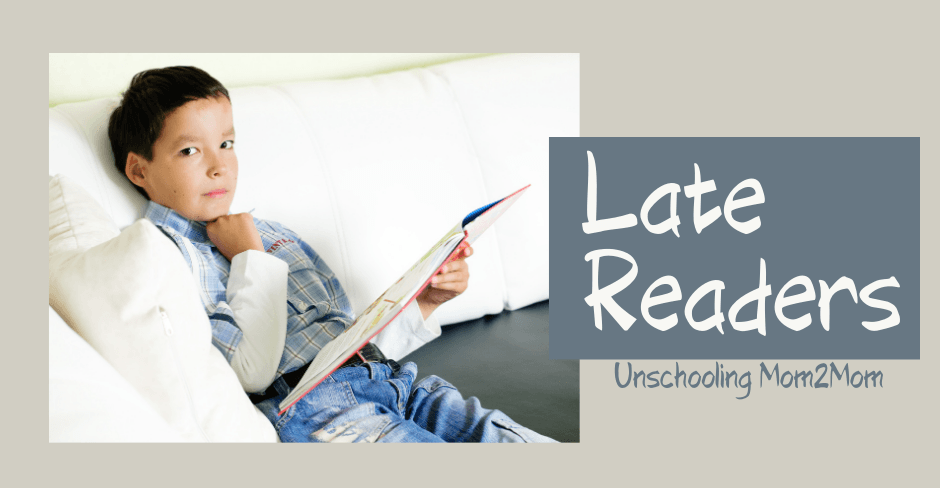
Late Readers

Guest Blogger

Several years ago, we put out a call for unschoolers to share what the road to reading looked like in their homes.
Paula Sjogerman shared what happened in her family in the hopes of helping others who may have similar scenarios.


It’s hard to step out of cultural norms.


Homeschooling, while more accepted these days, is one of those steps.
Unschooling is a giant step past that.
And when your kid is a “late” reader and you are okay with it, you’ve really crossed the line.

It never occurred to me that my children would not be the same kind of omnivorous readers their father and I are. When my first child started reading at the age of six, I thought that was pushing the boundary of what was right. Then, my second child did not read at six, or eight, or ten. But by then, I had become a better unschooler,and I was totally completely sure that it would all work out.


And it did!


Mid-way through his 11th year, he began reading, picking right up at the same level with most excellent readers his age. This could have all gone smoothly and happily - if we had lived in an isolated farmhouse with no television and no friends. But we live in a big city with tons of friends, some of whom went to school, and we love media of all kinds.

It’s impossible to escape the message that if you’re not reading, you’re dumb.

The sooner you read, the smarter you are.


So, when people say, “that must have been hard,”
I have to reply, “yes, it was.” It was really hard for my kid.


Even with a super supportive family and homeschooling group, he was bombarded by messages, both implicit and explicit, that he was deficient. He wanted to read so much, but he just wasn’t ready.

Now, way on the other side (he just turned 21), both of us would say it was worth it.

Learning to read was totally HIS, and he still loves to read.


I also believe that he gained some advantages this way. Without his nose buried in a book, he continued to look around at the world and hone his powers of observation. Because he wasn’t reading, he memorized - before rehearsals started! - the parts of Puck and Sir Toby Belch so as to not be embarrassed in our theater group.


From a Parenting Perspective

Letting his journey to literacy unfold naturally was also good for me.

It made me pay very close attention to each tiny step along the way.

It challenged me to stay true to my convictions about how humans learn.

It helped teach me patience.

Most importantly, I did not let the pressure spoil our relationship.

We continued to read aloud, talk about the ideas in books, have fun with wordplay, and never let the idea that he was somehow failing enter into our lives.


Now I have an adult child who likes books and still likes me.


This Guide WILL Help You!

If you're worried about how your child is going to learn how to read without curriculum, this full color 20-page mini-magazine is what you're looking for.

  • Learn how to create a literate environment within your home.
  • Conquer your own fears about how unschooling can work with reading
  • Read cutting edge research about how kids  actually  learn how to read
  • Discover SO MANY practical tips to make learning how to read a smooth process for your child

Inspiration     |    Tips    |   Guidance

Get this Guide!
Homeschooling vs Unschooling - what's the difference?
By Sue Patterson May 22, 2026
Unschooling vs homeschooling can feel very different day to day. Here’s why, what changes in real life, and how each approach shapes your child’s learning.
How Do You Know Your Child Is Learning Without Curriculum?
By Sue Patterson May 20, 2026
How do you know your child is learning without curriculum? Learn what to look for, how unschooling assessment works, and how progress shows up over time.
What to say to the kids if they feel behind - mom on couch with teen talking
By Sue Patterson May 18, 2026
Wondering what to say to your child if they feel they are behind? Understand typical reactions as well as the do's and don't of how to handle the situation.
Life skills Kids REALLY Need
By Sue Patterson May 18, 2026
Parents worry about grades, gaps, screen time. Let's discuss what prepares kids for adult life through unschooling / homeschooling: adaptability, problem-solving, confidence.
Do Unschoolers fall behind? Nervous mom  & nervous kid
By Sue Patterson May 14, 2026
Are unschoolers behind academically? Understand how learning works without grade levels or curriculum, and how to tell if your child is progressing over time.
Small plants above ground -  big root system underneath
By Sue Patterson May 11, 2026
Does unschooling feel like nothing is happening? Here’s why it can look lazy, what’s actually going on, and how to start trusting the process.
2 families with children - what does an Unschooling Day look like? Real examples by age
By Sue Patterson May 5, 2026
Curious what an unschooling day looks like? See real-life examples by age, understand why it feels unstructured, and how learning happens without a set schedule.
The Mother's Day Fairy - doorbell
By Sue Patterson May 4, 2026
Is it time for the Mother's Day Fairy to come to your house? What? You don't know about her? Let me explain...
Sue Patterson  Unschooling Podcast Is Unschooling Really Enough
By Sue Patterson April 28, 2026
Wondering what unschooling looks like on a typical day? Learn how real-life learning shows up, why it can feel unstructured, and how to know your child is actually learning.
By Sue Patterson April 9, 2026
Radical unschooling is often misunderstood as extreme, hands-off parenting or a rejection of learning altogether. In reality, radical unschooling is about going to the root of how children learn best — through connection, trust, and real life. It's not limited to academics - it's about ALL Learning. This post explains what radical unschooling actually means, what it doesn’t, and why it’s far more intentional than most people assume.
More Posts