“I Want to Do More to Teach”… Why That Feels So Confusing

When You Want to Teach More — but Feel Lost
In this post (and podcast/YouTube episode), we talk about:
- Why parents feel lost when they stop following the school model
- The belief that learning only happens when someone is teaching
- Why you don’t actually need to teach or plan for learning to happen
- What to focus on instead when days feel unstructured
A question came in that I want to share with you.
An unschooling mom wrote:
“I want to do more to teach, but I feel lost”
If that thought has crossed your mind— you’re not the only one.
A Common Parenting Concern
That feeling usually shows up when you step outside a system that taught us something very specific: that learning only happens because someone is teaching. So when you remove the teacher, the lesson plans, the follow-through, it can feel unsettling — like something important might not happen unless you make it happen.
Unschoolers know that isn’t true. But knowing it and feeling steady inside it aren’t the same thing.
Why Teaching Seems So Confusing
Here’s something that may sound strange at first:
You don’t actually need to teach.
You don’t need to plan lessons.
And you don’t need perfect follow-through.
Many of us are “in-the-moment” people — and that’s not a weakness. It’s often exactly what kids need. They need you to meet them where they are each day and help them live a full, connected life. When you do that, you can see their interests and their situations — and notice what the next step might be — without being pulled off course by expectations about finishing assignments or sticking to plans that no longer fit.
Maybe you go to bed with big plans...and wake up having no idea what they were.
Maybe the day just gets chaotic.
Maybe you’re tired.
That doesn’t mean you’re doing this wrong. It usually means you’re still carrying old ideas about what “teaching” is supposed to look like.
Before we go further, let me introduce myself. I’m Sue Patterson, and this is the Unschooling Mom2Mom podcast. I record these weekly pep talks to help parents get steadier footing when they’re doing something unconventional — especially when doubts creep in, from other people or from inside your own head.
My own kids are grown now, and I’ve worked with thousands of families over the years. What I’ve seen, again and again, is that learning doesn’t fall apart when you step away from school — but the idea that you’re responsible for making learning happen can be hard to shake.
You Don’t Actually Need to Teach for Learning to Happen
And that’s what’s really at the heart of this week’s question:
“I want to do more, but I feel lost.”
The parent who wrote in specifically said
teach more — and that’s an important word to pause on.
Because wanting to “do more” often means you’re still measuring yourself against a school-based idea of teaching. But unschooling asks something different. It asks you to wake up and notice what the day is offering.
- What’s the weather like today?
- Who seems like they might need a little more connection?
- What would make today feel interesting or satisfying?
Set aside school academics for the moment.
- What do your kids enjoy?
- What do they want to do?
- How would they like their days to unfold?
What to Pay Attention to Instead
The learning will happen as they do those things. And just as importantly, they’ll be building confidence in their ability to direct their own lives — noticing what they like, what they don’t, and how to seek out what they need.
If you’re nodding along, you don’t have to invent something new. Think about what’s already happening: stories they love, games they play, music they listen to, art they make, sports they enjoy, shows they watch, conversations you have in the car. These are not side activities. They’re the environment learning grows in.
You don’t have to orchestrate it all.
You don’t have to turn it into lessons.
You just have to notice what’s already there.
If You Want More Support
If it helps to see more examples, I’ve got a few places you can look — totally optional.
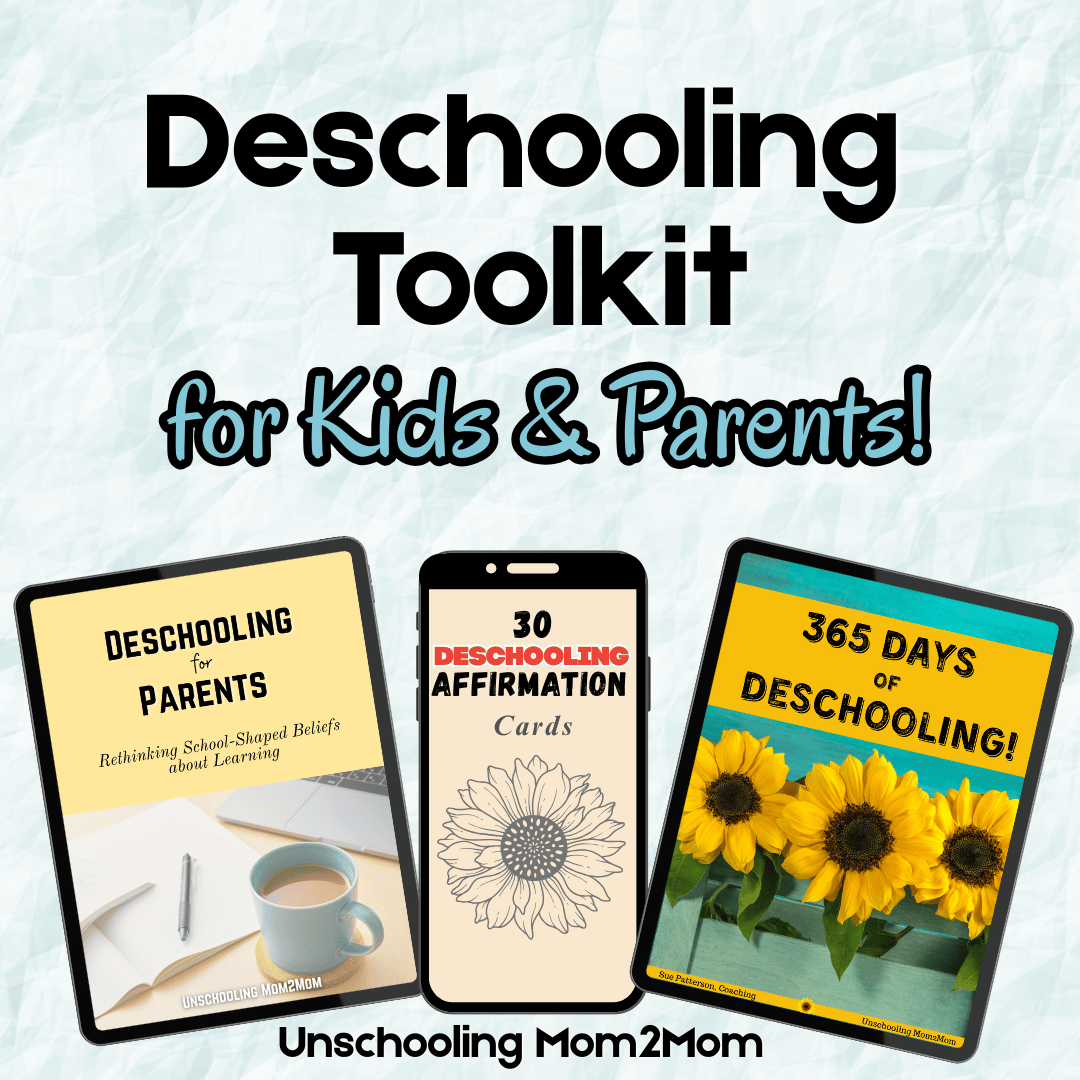
Below, you'll find a longer list of everyday activities, just to help you notice what’s already happening. And 365 Days of Deschooling, which is part of the Deschooling Toolkit, has lots of gentle prompts and ideas if you want something to glance at without turning it into a to-do list.
Learning Is Already Happening in Everyday Life
Your Observation Exercise:
1) What do the kids like to do alone?
2) What do they like to do with you, Mom?
3) What do they like to do with other adults in their lives?
4) What skills do you NOTICE they're developing or needing?
Simple, right?
This list can help you get your wheels turning on thinking about the types of things that your days can be filled with.
And if your brain resists, demanding to know when the
learning is going to happen, that’s a red flag for more
deschooling.
I have a TON of resources on deschooling —an entire deschooling playlist at Youtube.
But if you want one quick PDF you can peruse to see examples of the subjects that show up in typical activities in your daily life, grab the Everything Counts PDF.
You can do this. You’re just working against all those years of conditioning.
School told you there was only one right way.
One right answer.
And one path to get there.
It’s just not true.
- Types of Books they love to read
- Books they love for you to read aloud
- Audio books in case your eyes are tired
- Podcasts for kids
- Board game favorites
- Card/Dice Games
- Building Toys
- Arts/crafts
- Sports (solo or team)
- Dress Up/Pretend Play
- Music
- Theatre/Performance Opportunities
- Technology (videos, graphic/web design)
- Physical Activty - gyms, playscapes, etc.
- Outdoor Activity at home
- Technology: Games
- Local trips they’d like to make
- Local trips you’d like to make with them
- Community activities
- Activities to plan/do with friends
- Science Kits
- Netflix/Streaming Favs
- YouTube Favs
- Favorite Apps
And if you’re in the Creating Confidence membership, I’ll have a simple resource you can use if you want to keep track — or just make things more visible to yourself. I love creating PDFs for things like that, but honestly, you could do the same thing in a basic Google document.
You might jot down the things your kids enjoy doing on their own, the things they like doing with you or other adults, and as you make that list, you may start to notice patterns — interests that keep showing up, or skills they’re naturally wanting to improve. And if not, that’s fine too. You can treat it as a simple observation exercise.
The point isn’t to manage or orchestrate learning — it’s just to help you see it. Because once you start noticing what’s already going on, that feeling of being lost tends to quiet down.
If you came in thinking,I want to do more to teach, but I feel lost, I hope you’re leaving with a slightly different question — not
what should I teach? but
what’s already happening here?
The clarity will come from noticing what’s already unfolding in your days. That shift alone can change a lot.
If you have a question you’d like me to unpack on a future podcast,
let me know. These questions are often shared by more parents than you realize. I’ll talk to you again next week.