Can Parents and Teens Be Friends?

When people are uncomfortable, they tend to rely on axioms and phrases that may or may not have any validity at all. They comfort themselves with a familiar fairly-universally accepted phrase … then they don’t have to think that hard about it anymore.
Raising teenagers can sometimes make parents doubt themselves. They find themselves in a position where they’re looking for some answers, and they wish some of it was easier to figure out. But if we really look at the advice people have shared through generations, we might discover that much of it isn’t even applicable – not if we’re trying to actually have a relationship with our teenager!
For instance, we’ve all heard,
“I’m not your friend! I’m your mother!”
- But what does that really mean?
- Is it impossible to be both?
- Do we really want both?
Instead of getting caught up in some globalized phrase about parents not being friends, let’s examine both sides of this coin. Could we implement the characteristics of a friend – or is that a bad idea?
Get Support during the Teen Years!
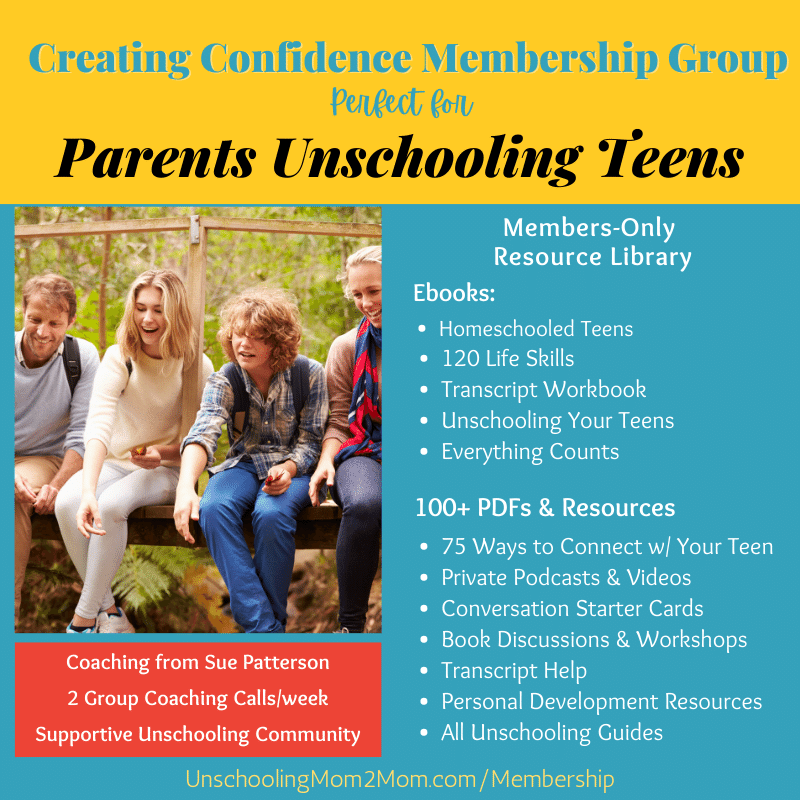
My popular Creating Confidence Group Coaching program has so many materials and resources specifically for families who are Unschooling Teens!
- All ebooks from the Unschooling Teen Toolkit!
- Group Coaching Calls
- Workshops/Guest Speakers
- Transcript Workshop
- Collection of articles/recordings that pertain to the teen years
Also! Sometimes kids demonstrate typically adolescent behaviors BEFORE they're actually teens. Learning how to partner with them will prevent bigger power struggles down the road. You may need to implement some of the strategies we talk about before the teen years!
You don't have to do this alone!
What do friends do?
Friends trust each other.
They share information about what they’re doing, who they’re with, what they’re trying – why would a parent not want that? If you have your child’s trust, you will be in so much better position to guide or offer advice from your experience. They’ll listen to what you have to say.
If you’ve spent time developing the relationship, you’ll react without all that anxiety that pops up. Letting go and trusting them is scary. But far less when you have a good relationship and your child shares what’s really going on with them.
Building trust takes time, and how we parented them when they were younger will have a direct effect on the relationship we have with them as teenagers. So the earlier we start approaching our interactions with them as partners instead of adversaries, the better.
When parents find themselves pulling
The Mom Card, often what they are saying is that they want blind obedience. They want their teen to value what they have to say, and follow their instructions. Parents have a whole lot of fear swirling around in their heads. And the teen years tend to trigger some of our worst memories. It’s not surprising that we want to clamp down and make it all go smoothly.
The problem with this approach, is that we’re not the only human with decision-making capabilities. And – perhaps even more importantly – it’s their life, not ours. We all make mistakes. Sometimes we can learn from other people – if we trust them (see how that works?) – and sometimes we have to learn things the hard way. But that’s just part of Life.
This isn’t terribly unfamiliar to most parents. Remember when your teen was three and they were making their bed on their own (or fixing a sandwich later, or building a fort)? I know, it seems like YESTERDAY! We recognized the importance of not jumping in to “fix” what they had done. We realized that that was how they learned, their confidence would grow, and they would get better with time.
The same applies with teens:
Getting more confident with your teen’s ability to make decisions in their world, comes from giving them room to make those decisions.
Operating from an authoritarian position creates obstacles in the relationship.
When teens know they can bring their problems and concerns to you and not fear your judgement or worry about punishment for choosing something different, they will be more likely to listen to what you have to say. And, as parents, you’ll get another glimpse into their world and how they’re handling things. We can’t expect our teens to tell us everything. That’s part of their development.
Nor can we, as parents, share our own problems with them – that’s something we need to do with our own peers and friends. So, while I wouldn’t call it a two-way street, I would suggest that becoming friends with your teenager is a good thing.
What kind of parent do you want to be?
Think about how you define being their mom.
What characteristics are important to you?
Set aside what you think society expects you to do, and think about what kind of mom you wish you had had. Work toward that idea! And maybe it’s time to share that with your teens.
Is it something they see or want from you?
Opening up this communication will be so helpful for both parents and teens to understand each other. You may have heard unschoolers refer to this as a more "partnership parenting"approach. Partnering with our kids helps create stronger relationships, builds trust, and gives the kids practice in communicating within a healthy respectful environment.
Take a look at some of those parental tips that get passed down through the generations and see if they really apply. Don’t buy into them, just because it’s an easy phrase to use to basically dismiss looking at a situation more closely.
There is no need for either/or, us against them, friend vs. parent.
Initially published for Mother's day in May 2013