Fun November Strewing Ideas—Perfect When Homeschool Burnout Is Creeping In

Fun November Activities for Kids
- Notice what changes when the clocks fall back.
- Build the ultimate sandwich for Sandwich Day.
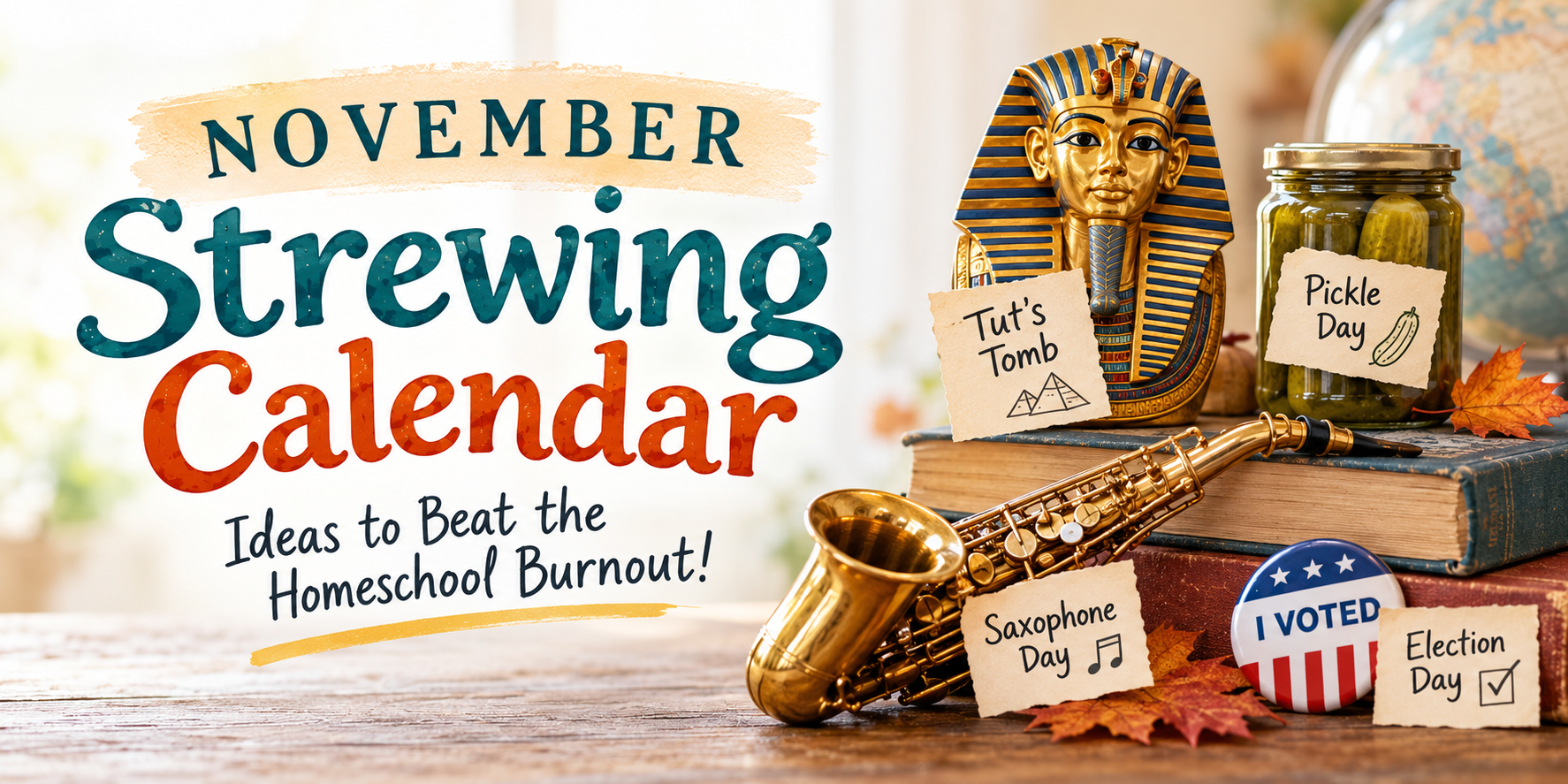
- Talk about how voting works on Election Day.
- Listen to jazz and learn who invented the saxophone.
- Find Fibonacci spirals in pinecones, sunflowers, and shells.
- Discover King Tut’s tomb on the anniversary of its discovery.
- Go outside for Take a Hike Day or watch for the Leonid meteor shower.
- Taste-test pickles, or try making your own.
- Do something kind for World Kindness Day.
What Is Strewing?
Strewing is bringing interesting ideas, books, videos, or activities into your child’s world and seeing what catches their attention.
No lessons. No workbooks.
No pushing. Just possibilities.
Podcast Transcript:
It’s November. The shine of the new homeschool year has worn off.
The curriculum you were so excited about in August is sitting on the table, and nobody wants to open it. The kids are rolling their eyes. They’re dragging their feet. And your fuse? It’s SHORT.
This is definitely not what you thought homeschooling was going to be.
Maybe you’re not sure about unschooling. But you can clearly see that the traditional way, the one that looks an awful lot like school no matter how you spin it, just isn’t cutting it.
So before you throw in the towel and send them back to school, I want you to try something.
.
Did you know November 3rd is Sandwich Day?
Stick with me. I’ll show you what I mean.
Hi everyone, welcome to
Unschooling Mom2Mom.
I'm
Sue Patterson and this is your weekly Unschooling Pep Talk.
Even if you’re not unschooling, you’ll find these little podcasts helpful as you relax into a new approach to learning over at your house. My own kids are grown now, and I want to share what worked and what didn’t.
I have ways we can work together, so if you’re stressing, be sure to go over to the website and see the options:
—whatever works best for you!
Now, let’s talk about sandwiches.
Maybe you mention that Sandwich Day is coming up, and your child decides to build the most ridiculous sandwich ever.
They plan it out. They figure out what you have in the fridge and what needs to go on the grocery list. They wonder how tall it can get before it falls over. They cut it so everyone gets a piece.
Maybe they want to know why it’s called a sandwich. (There really was an Earl of Sandwich.) Maybe they look up what sandwiches people eat in other countries.
Or maybe they make peanut butter and jelly, eat it, and go back outside.
That’s okay too.
The point isn’t to turn Sandwich Day into a lesson.
The point is that when kids are engaged in real life, learning weaves its way in. Planning, measuring, reading, history, geography, cooperation. Your child isn’t thinking about subjects. They’re making lunch.
The subject labels are for us.
This is so different from curriculum.
If you’ve been fighting to get your kids through the workbook, this might feel a little strange.
With curriculum, you start with the lesson and then try to get the child interested.
With strewing, you start with something interesting and notice where it leads.
Strewing is simply bringing possibilities into your child’s world and seeing what catches their attention. You aren’t assigning it. You aren’t disguising a lesson. You’re just offering ideas they can run with.
And when you stop pushing, something shifts. The eye-rolling eases up. And so does your fuse.
November is full of possibilities.
This weekend,
the clocks fall back. Suddenly it’s getting dark before dinner.
Why do we do that? Who decided? Does everybody in the world change their clocks?
(I did a whole episode on
Daylight Saving Time last spring, and it’s amazing how many directions one topic can go.)
Election Day is the same first week if you're in the USA. Kids can learn how voting works, why we have elections, and what happens at a polling place. Do you take the kids with you to vote?
One Tomb, So Many Directions
And then there’s November 4th. This one’s a favorite of mine, so let me show you how far one little celebration can go.
A man named Howard Carter found a step buried in the sand in Egypt’s Valley of the Kings. That step led down to the tomb of King Tutankhamun, and it turned out to be one of the most famous discoveries in history.
This is super fun for kids. There’s treasure. There’s a boy king. There are mummies. There’s even a rumored curse.
So maybe you mention it at breakfast and see what happens.
One child might want to know how mummies were made, and suddenly you’re talking about preservation, anatomy, and why the dry desert kept things intact for thousands of years. That’s science.
Another might want to find Egypt on a map, follow the Nile, and figure out how far away it is.
That’s geography.
Someone might try writing their name in hieroglyphics. That’s reading, writing, and the idea that people have recorded language in all kinds of ways.
Your kid who loves numbers might wonder how the pyramids were built, or how the ancient Egyptians counted. That’s math and engineering.
And the curse? People said anyone who disturbed the tomb would be doomed, especially after the man who funded the dig died a few months later. Was it real? Why did people believe it? How do rumors spread? That’s history, critical thinking, and even a little media literacy.
Maybe one of your kids decides archaeologists have the coolest job on the planet.
Or maybe they just think the golden mask is pretty neat, and that’s the end of it.
Either way, you didn’t have to plan a unit study on ancient Egypt. You mentioned something interesting, and you followed where their curiosity went.
But Wait! There's More!
Then there's
Saxophone Day, for the child who might enjoy finding out that one man invented an entire instrument.
Pickle Day
— you could do taste tests!
World Kindness Day. Take a Hike Day
for your outdoorsy child.
And November 23rd is
Fibonacci Day, because the date reads 1-1-2-3, the start of the Fibonacci sequence. Your kids might go hunting for spirals in pinecones and sunflowers without ever realizing they’re doing math.
Then there’s Thanksgiving, with history, cooking, family stories, and a whole lot of measuring.
You don’t have to do all of these. Some will be a ten on the Fun Factor Scale. Some will be a six. Some your kids won’t care about at all.
That’s fine. You’re adding more possibilities to the buffet and paying attention to what they choose.
Making this easier for you
Now, you could go looking for all of these yourself. But that’s just one more job on your plate, and your plate is already full. That’s why I created the Strewing Calendar.
You get a printable calendar with something fun for every day of the month. Hang it up and let everyone circle what sounds interesting.
Each day there’s a post with photos, fun facts, and links for exploring further.
And I’ve included learning objectives for every day. Those aren’t for your kids. They’re for you. If you’re coming from traditional homeschooling, they help you see the math, science, history, and reading inside things like sandwiches and pickles. And if your state needs progress reports, the language is already there for you.
It’s perfect for families who are kind of in between. Not quite traditional homeschoolers anymore, not quite unschoolers yet. And it’s great if you are unschooling but you need a little bit of structure to feel okay about how the day is going.
Most people sign up for six months or a year.
But if you’re on the fence, I made a month-by-month option too. It’s $9 a month, and you can cancel anytime.
Try November and see what happens.
I’ll put the link in the show notes.
And if you want more support, coaching, and other parents to talk to, the Strewing Calendar is also included in the Creating Confidence Community.
You Don’t Have to Know the Answers
When you’re using curriculum, you’re the teacher. You have the answer key. You’re supposed to know the material, explain it clearly, and check that it got done.
That’s a lot of pressure.
And... it’s a big part of why so many parents are exhausted by November.
Strewing takes that weight off your shoulders.
You don’t have to know anything about saxophones to mention Saxophone Day. You don’t have to understand the Fibonacci sequence before your kids go looking for spirals. You don’t have to be an expert on ancient Egypt to wonder out loud what it was like to open King Tut’s tomb.
When your child asks a question you can’t answer, you get to say, “I don’t know! Let’s find out.”
And that is one of the most powerful things they can hear from you.
Because it shows them that learning isn’t something that only happens to kids. Grown-ups keep wondering. Grown-ups look things up and get excited about stuff they never knew before.
Some of my favorite memories with my own kids came from moments when none of us knew the answer, and we went digging together.
You stop being the person standing at the front of the room. You become the person sitting next to them, just as curious. Modeling curiosity.
That’s not lowering the bar. That’s how learning works for the rest of our lives. You don't need a curriculum to make learning happen.
You just need some interesting ideas to bring into your days WITHOUT adding more to your plate.
Learning will weave its way in - it always does.
Happy Unschooling.
Reach out if you need some good ideas for the month!
And I'll talk with you again soon.