
My Teen Sleeps All Day, Games All Night
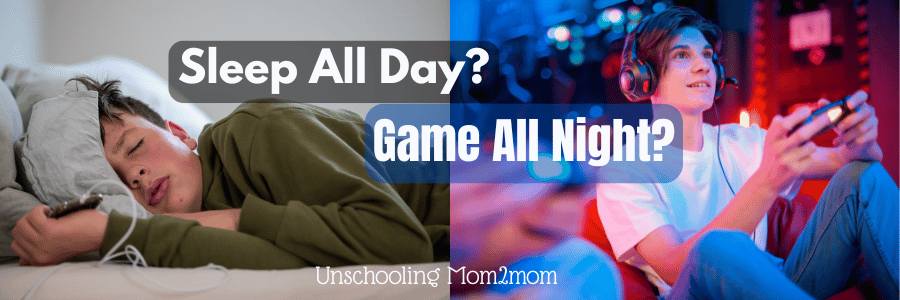
Should I Be Worried?
Few things make parents question themselves faster than a teenager who seems to be living on a completely different schedule than the rest of the family.
You wake up, start your day, answer emails, run errands, make lunch, and at some point realize your teen is still asleep.
Hours later they finally emerge from their room, grab something to eat, and slowly begin their day.
By the time everyone else is thinking about dinner, they seem to be waking up.
By the time the rest of the family is heading to bed, they're settling in for a long gaming session with friends.
It's not hard to see why this makes parents nervous.
Most of us have been taught to associate early mornings, productivity, and busy schedules with responsibility. Sleeping until noon and staying up until two in the morning feels like the opposite.
Even if we don't say it out loud, it's easy to start wondering what this means for the future.
Will they be able to hold a job?
Will they be able to manage college?
Are they learning how to be responsible?
Are they becoming disconnected from the real world?
Those questions keep us up at night, right?
Looking Beyond the Schedule
One of the things I encourage parents to do in situations like this is to look beyond the sleep schedule itself and pay attention to the bigger picture.
A teen who sleeps until noon can look very different depending on what the rest of their life looks like.
Some teens wake up and immediately connect with friends, dive into projects, pursue interests, create things, solve problems, and engage deeply with the world around them.
Others may be struggling with depression, isolation, anxiety, or challenges that have very little to do with gaming.
From the outside, both situations can look surprisingly similar.
That's part of what makes this difficult.
The schedule is easy to see. The reasons behind it are often much harder to understand.
Teenagers Are Already Changing
Adolescence is a period of enormous change, and not all of those changes are comfortable for parents to watch.
Many teens naturally begin staying up later than they did when they were. younger. They want more independence. They become more private. Their social lives become increasingly important which leads many of them to spend more time with peers and less time participating in family activities.
Parents sometimes interpret these shifts as signs that something is going wrong when, in reality, many of them are normal parts of growing up.
That doesn't mean every late-night gamer is simply experiencing typical adolescent development.
But...gaming is often sharing space with other changes that are already happening.
When we focus only on the gaming, we can miss the larger picture.
Nighttime Is Often When Their Social Life Happens
One thing many parents overlook is that gaming is often as much about friendship as it is about games.
For a lot of teens, evening is when their friends are available. It's when people log into Discord, join voice chats, organize game sessions, and spend time together. What looks like a teenager sitting alone in a room may actually be a teenager participating in their primary social community.
I've talked with many parents who assumed their teen was spending hours isolated, only to discover they were talking, laughing, planning, collaborating, and connecting with friends the entire time.
So that's a good reminder for parents. When you're looking at your teen, gaming late into the night, they may be looking at friendship, community, and social connection as much as they are looking at a screen.
The Questions I Would Be Asking
When parents describe a teen who sleeps all day and games all night, I find myself becoming curious about things that have very little to do with gaming.
- How is your teen doing emotionally?
- Are they engaged with things they care about?
- Do they have friends and meaningful relationships?
- Are they pursuing interests outside of gaming, even if those interests show up in unconventional ways?
- Do they seem curious, motivated, and connected to life?
Those questions tend to tell me much more than a bedtime ever could.
A sleep schedule can be adjusted. A gaming habit can change.
What matters more is understanding what's happening underneath those behaviors.
When It Makes Sense to Pay Closer Attention
There are situations where a parent's concern deserves a closer look.
If a teen seems deeply unhappy, withdrawn from all relationships, unable to engage with anything they previously enjoyed, or is experiencing significant physical or emotional distress, those are important signals regardless of whether gaming is involved.
The concern in those situations isn't simply that they're playing video games.
It's that something else may be going on that deserves attention and support.
Looking at the whole teen matters here too. Focusing entirely on the screen can sometimes distract us from the larger issues that actually need our attention.
When You're Living It
One of the hardest parts about parenting teenagers is that you rarely get the full picture all at once.
You're trying to understand a human being who is changing rapidly while also carrying all of your hopes, fears, and worries about their future.
It's easy to see a sleep schedule and imagine where it might lead.
It's much harder to slow down and look at what's actually happening today.
That's one of the reasons these conversations come up so often inside the Creating Confidence Community. Parents bring questions like this all the time because the situation rarely feels as simple from the inside as it does from the outside.
Sometimes it helps to talk through what you're seeing with people who understand both the fear and the complexity. When we look at the whole picture together, parents often discover there is more going on than they initially realized.
And sometimes that shift in perspective changes the conversation entirely.