Unschooling Community – Finding it or Building it?
Are you looking for an Unschooling Community?
Many of us do better when we have a trusted community to hang out with!
Here are some tips to finding community or building it yourself. This podcast will give you some tips and some suggestions for both. Remember, one size does not fit all - so you may need to create something that works for you and your kids.
Podcast Transcript:
One of the issues a lot of people face early on, is the desire to find an unschooling community. A few states have a lot of unschoolers - many of these creating their own park days or get togethers. This is an ever-evolving scenario though. Kids get bigger, their interests change. The families move in a different direction and stop coordinating particular activities. And, then someone else steps up because there’s a need - usually their own child has an interest and would enjoy it more with other kids around. It's a grassroots way of organizing.
So that’s what I want to talk about this week - finding or creating the communities you need. We moved a lot. And sometimes we tapped into what was there, finding families we could connect with. And other times, we didn’t find what we needed, so we created a new community. Don’t worry, it’s not as daunting as it sounds!
When we talk about community-finding and building, I want to remind you that it’s not a one-size-fits-all. We all can do it differently.
And, when we talk about community, some people might be talking about creating a support community where like-minded people (or even those who share a particular interest) get together. While others might be talking about the community where you live, urban, rural, suburban- and tapping into what's available there.
Looking for Community?
If you'd like to surround yourself with other unschooling parents who are traveling on this path.
I LOVE this group! So supportive and kind. You'll love it too.
You really don't have to do this alone!
Finding Support Communities
But for this, let’s talk communities from a support standpoint. After this past year, people are much more accepting of the concept of online support communities - because that’s primarily all that was available. These will probably continue because they’re so easy to connect with.
I have several on social media available for you - Unschooling Mom2Mom in FB or IG.
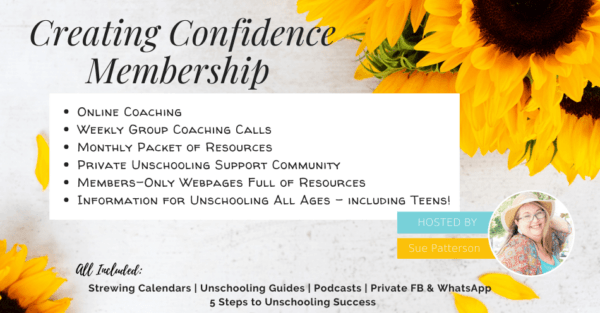
And then taking it up a notch with my Creating Confidence membership community where we talk via zoom multiple times a week, and have a WhatsApp chat for in between.
So you might do that AND look for local community too. I’ll put a link below to help you find local groups, and you can see if you can find people venturing out and connecting.
The most active time for most support groups is in the Fall (August/Sept for us in the states) but probably whatever months are near the times that kids head back to school where you live. It’s the time to go and introduce yourself. It’s also when families decide to get together to do various activities, and your kid might like to be included. So don’t miss this time of year. It kind of falls off in the spring and summer months, as families get busy with their own things or homeschool moms start to burn out a little.
Support groups (listed here at the website) typically offer a variety of things - a NOT Back-to-School Party (ours seemed to usually be at a big swimming pool) but they can be anywhere. Park days, field trips, group activities - usually whatever the kids are interested in.
Lots of times we participated in groups that were more eclectic - a mix of homeschooling methods represented. The kids usually didn’t care - they just wanted the group activity or hanging out with other kids. I found it always helpful to search for the common ground with the other moms - and then wander off to push kids on swings when the conversation shifted to curriculum! You don’t have to have an unschooling-only group though. Not that you want to be around too many vocally ANTI-unschooling - that can wear you down. You’ll have to figure out what will work for you.
Unschooling- Friendly Conferences (also listed here at the website) are fun! You can travel to them, to get the experience of being around a lot of unschooling families too. Once the pandemic ends, I think these will resume. They’ve continued as online/Zoom-style conferences, but real life conferences are pretty fun. Lots of kids - and parents - create some really strong friendships by participating year after year.
Need Ideas?
This Unschooling Guide is full of inspiration for you during the
"Back to School" Season.
Whether you're looking for ideas for your own NOT Back-to-School Party, or need to figure out why this time of year is so hard for you, this Unschooling Guide will walk you through it all!
Why reinvent the wheel?
Building Community Yourself
What do you do when you don’t find local unschooling groups or any groups that work for you? Or maybe the groups that exist are more home schooly than unschooly…
It’s possible that the existing groups aren’t going to meet the needs of everyone in your family. Not that you need to only be around other unschoolers - not at all. But we all know what it's like when it's not a great fit. Often when we moved to new places, I'd show up at the activity, scanning the room for other people I could connect with. Maybe they weren't that crazy about the group either, but it was all that existed. So those are the people you get to know more.
You may have to create group activities yourself. But it doesn’t have to be a giant undertaking. You can post onto a local FB group or email list that you’d like to do a regular park day or hike in the area. Maybe it would be a MONTHLY hiking group and the kids could help choose where to go each month.
There are two really positive aspects of coordinating the groups yourself:
- You get to control the calendar. You can make it when it works for you. Of course, you may want to check with the others, to be sure that other families could come too! But you get the final say.
- You choose activities that your own kids enjoy. That way, if not a lot of people show up, it’s still fun.
Activities can be simple like potlucks and water play.
Messy crafts are more fun to do with other kids sometimes - and other moms are often eager to let anyone that loves that host it instead of them.
But maybe it’s monthly get togethers at a local nature center with the naturalist there to guide a little. When we lived in Alaska, we worked out a deal at our favorite Nature Center, and the Naturalist offered her regular Saturday Kids’ Nature Classes for us on Fridays. In exchange, we bought family memberships and paid a couple of dollars per kid. It was great.
It doesn’t take a lot to call up - anywhere really - and see if they’ll offer something for a small group. And then you negotiate the fee.
We had photographers do teen classes around town - bring your camera, and shoot different things WITH someone who knew what they’re doing.
We had community service projects that happened monthly. We tried out different projects and then continued with a handful.
We became Girl Scout leaders to make sure the troops had fun activities instead of a more schooly approach.
We found out when Sky Parties existed where kids could look through telescopes and ask questions.
We coordinated Magic Shows where magicians came to perform for a small group. The same for Puppet Shows, Improv Actors, and even an unemployed zoologist who brought a bunch of animals for the kids to see. Sometimes they were one-and-done activities - which might be a good fit. You can always host Movie Nights, or Tie Dying, or Sing-A-Longs. You know whether your life is more chaotic, or if you'd do better with a little regularity.
3 TIPS FOR COMMUNITY BUILDING
Best Days.
If you're setting up a more ongoing/recurring get-together. Host things on Fridays. No one likes Monday get-togethers, it seems. And local homeschoolers may participate in your activity - and use it as “incentive” for their kids and their week of school work… “If you want to go to the Patterson’s thing on Friday, you’ll have to finish this work.” I’m not a fan of that, obviously, but it is what it is. And we wanted more families to participate.
Written Communication.
Print out “announcements” or invites to activities, so you don’t have to talk to everyone in a group - you just hand out your colorful piece of paper at the next event!
And now, online, that’s even easier! You could start your own Facebook group that's only about "field trips" in the community. Or whatever is interesting to your child - and more fun to do with other kids. Other families will probably want to join you - but you have to let them know you're there!
County Extension Office - 4H.
Check with the local extension office. We were able to create 4H groups that didn’t have anything to do with animals. They usually have a lot of kids participating, and they’re really grateful to have adults agree to lead the groups. We led 4H groups that did community service as well as small theatre productions and acting. My kids also participated in Quiz Bowls (trivia themed competitions), dog training, and various leadership camps. I mention all these because sometimes parents don’t know that 4H is an option for way more than showing animals!
You Can Do It!
After polling the Unschooling Mom2Mom community on Instagram, I was surprised to learn that a LARGE number of unschooling parents lean toward being introverts. So I realize this is hard. But if your kid needs you to push through a little of that, it’s doable. I’ve seen lots of introverted mamas pull it off.
There really are as many options of activities as your community offers - or you and the kids can dream up!
I hope this helps a little bit, as you’re trying to figure out how to find or create a community that can work for your kids. We brainstorm about this in my coaching group, if you’d like more ideas and input.