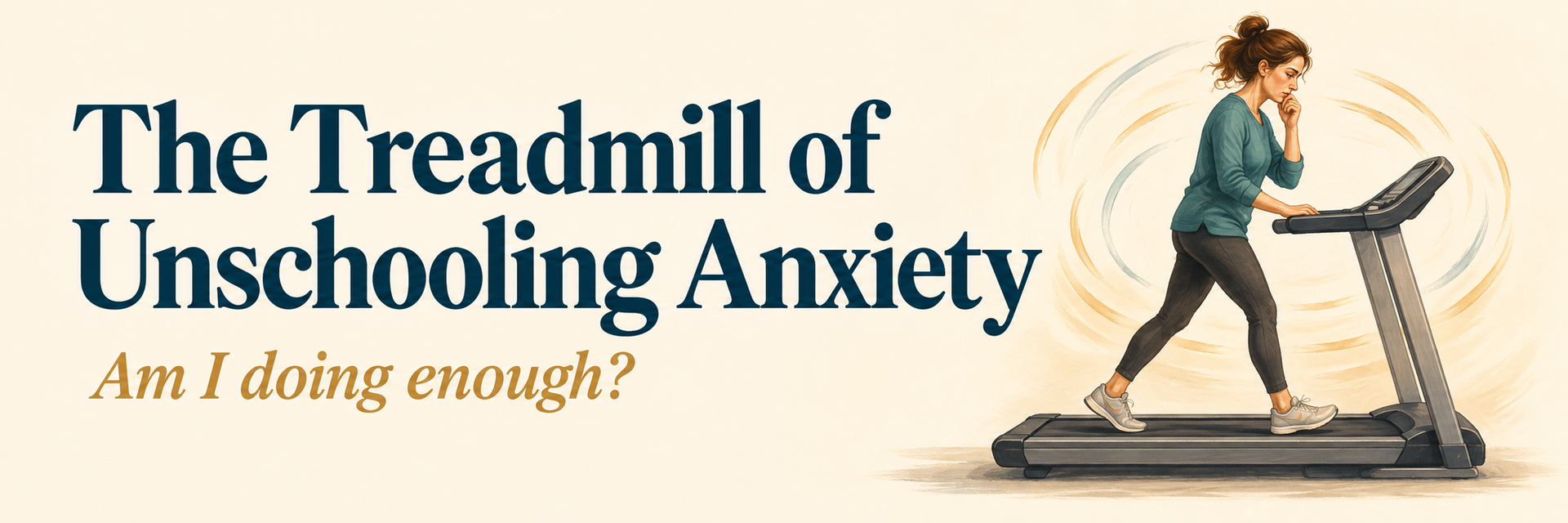
Why Does It Feel Like Unschooling Isn’t Working?

Many unschooling and relaxed homeschooling parents worry their children aren’t learning enough when they don’t follow the expected timeline for reading, math, or independence. We may have left school behind, but we’re often still using its milestones to measure progress. Those hidden timelines can turn ordinary uncertainty into fear—and make us overlook the learning and growth happening right in front of us.
Why School Timelines Follow Us Into Homeschooling
I have to admit, before this past month, I hadn’t thought all that deeply about timelines.
Of course, I knew schools use timelines in ways that unschoolers don’t. Schools have grade levels, benchmarks, scope and sequence, and predetermined ages when children are expected to read, understand fractions, write an essay, or move on to the next subject.
And I’ve talked for years about how children don’t all learn the same things at the same age. That part wasn’t new to me.
But throughout July, I’ve been showing up every day inside Creating Confidence to break this idea of timelines into small, manageable pieces. We’ve talked about our children’s learning timelines, the timelines we have for our homes, and even the timelines we carry for ourselves as parents.
And the more I unpacked it—and the more I heard it appearing in our coaching conversations—the more I realized that timelines are connected to nearly every fear that makes unschooling difficult.
They aren’t only a way of organizing school.
They’re one of the ways we’ve learned to reassure ourselves that everything is going to be okay.
If my child reads by this age → then they’ll be ready for what comes next.
If they’re doing grade-level math, → then I haven’t missed anything.
If my teenager has a plan, →then they’ll become an independent adult.
If our home is peaceful and productive, →then unschooling must be working.
The timeline gives us a sequence. And the sequence gives us the feeling that we can predict the outcome.
So when our child steps outside that sequence, we aren’t only reacting to what is happening today.
We’re reacting to everything we’re afraid it might mean about tomorrow.
Why Unschooling Parents Worry Their Children Are Behind
A child isn’t reading yet, and our mind doesn’t stop with, “They aren’t reading right now.” It races ahead.
What if they never read?
What if I should have pushed harder?
What if I’ve waited too long?
What if they can’t do the things they want to do later because I didn’t make this happen sooner?
A teenager doesn’t have a plan, and suddenly we’re not looking at a fifteen-year-old who is still exploring.
We’re imagining a twenty-five-year-old who can’t support themselves.
Our home has had a difficult week, and we don’t simply think, “This was a difficult week.”
We wonder if this means our entire approach is failing.
That’s the timeline underneath the timeline.
The worry we say out loud may be about reading, math, motivation, independence, screens, friendships, or future plans. But underneath it, there’s usually another question:
What am I afraid this will mean?
That’s a question I often ask parents on our coaching calls because it helps us separate what is actually happening from the future story, fear has built around it.
Those aren’t always the same thing.
There may be something happening today that needs our attention. A child may be struggling. They may need more support, different resources, a professional evaluation, or simply a parent who slows down long enough to understand what’s getting in the way.
Letting go of a timeline doesn’t mean we stop paying attention.
But we can’t respond clearly when we’re treating a prediction as though it’s already a fact.
Why Unschooling Can Be So Hard to Trust
And I think this is one reason unschooling can feel so much harder than we expected.
We may believe in interest-based learning.
We may understand that children are naturally curious.
We may see learning happening through games, hobbies, conversations, projects, friendships, and everyday life.
But the timeline used to tell us whether it was enough.
Even when we didn’t particularly like the school system, its benchmarks gave us something to check. There was always a next lesson, a next grade, a next milestone. We could point to the completed workbook and reassure ourselves that our child was moving forward. Even if the workbook wasn’t completed, we were giving ourselves a grade - ok, ¾ done - good enough. Measuring ourselves.
But Unschooling asks us to look more closely.
It asks us to recognize growth that doesn’t always arrive in a neat sequence.
It asks us to notice connections that may not become visible right away.
It asks us to respond to the actual child instead of continually comparing them to a predetermined plan.
And that requires us to tolerate more uncertainty.
I think that may be the part we don’t talk about enough.
We sometimes describe unschooling as though the difficult part is finding enough activities or knowing how to keep learning alive without curriculum.
But often, the more difficult work is learning to live without the false reassurance of a timeline.
It’s learning not to demand proof before the learning has had time to unfold.
When Your Child’s Progress Feels Like a Test of Your Parenting
It’s also learning not to use our children’s progress as a report card on our parenting.
Because that happens too.
When our children are visibly thriving, we feel confident about our choices.
When they’re moving more slowly, struggling, or doing something other people don’t understand, we may feel exposed.
Their progress begins to feel like evidence that we’re either succeeding or failing.
And without realizing it, we may begin pressuring them—not because pressure is what they need, but because we need them to reassure us.
Why Deschooling Takes Longer Than We Expect
Timelines don’t only affect the children, either.
We have timelines for ourselves. You might be measuring your own progress with a timeline. Like...
"I thought I’d trust unschooling more by now."
"I thought I’d be finished deschooling. I thought I’d stop comparing."
"I thought I’d be more patient."
"I thought I wouldn’t keep panicking every time someone asked what my child was learning."
We even turn letting go of timelines into another timeline.
The more I thought about it, the more I realized we even have timelines for our homes. Expectations that we think ought to be happening - BY NOW.
It’s that “By now” part that shows you you’re measuring yourself against Something.
We thought our days would feel calmer. We imagined everyone happily pursuing interests while we offered fascinating resources and had meaningful conversations over lunch.
Sometimes it does look like that.
And sometimes people are tired, irritated, bored, unsure what they want, or uninterested in the wonderful thing we brought home for them.
A real home doesn’t unfold according to some imaginary perfect unschooling timeline either.
How to Recognize Learning Without School Benchmarks
This is why I keep coming back to slowing down and taking off the blinders.
Fear tells us that there’s one narrow path and that if our child steps off it, we need to hurry them back on.
It keeps our attention fixed on the milestone they haven’t reached or whatever skill they aren’t practicing.
When we take off the blinders, we can see more of the child.
We may notice what they are learning, how they solve problems, what they return to, where their confidence is growing, and what kind of help they’re actually ready to receive.
We may also see a real concern more clearly because it’s no longer tangled up with ten imagined future disasters.
We also may see that the path wasn’t as narrow as we thought. We have room to meander along the side.
OK...that leads us to the next obvious question:
How Do You Know If Unschooling Is Working?
So if we let go of the timeline, what replaces it?
Not blind trust. Not ignoring problems. And not standing back while our children figure out everything alone.
We replace the timeline with attention.
We observe. We stay connected. We offer resources and opportunities. We help our children solve the problems that matter to them. We notice when something isn’t working, and we remain willing to adjust.
Instead of asking only, “Are they where they’re supposed to be?” we can ask:
- What is actually happening right now?
- What growth am I seeing?
- Is my child engaged with life?
- Is there a struggle that needs support?
- What am I afraid this moment means—and do I actually know that to be true?
- What would be helpful today?
Those questions don’t give us the certainty a timeline appeared to offer.
But they give us something more useful: a clearer picture of the child in front of us.
How to Let Go of School Expectations and Trust Unschooling
After spending this month thinking about timelines, I don’t believe we can simply announce that we’ve rejected them and be finished.
Most of us have spent our entire lives absorbing these ideas. They’re woven into how we understand childhood, learning, productivity, success, and even responsible parenting.
We aren’t going to dismantle all of that overnight.
But we can begin to notice it.
We can catch ourselves when one difficult moment becomes a prediction about our child’s entire future. We can separate an observation from the frightening story we’ve attached to it. We can recognize when we’re asking our children to relieve our anxiety by moving faster.
And then we can come back to today.
July may be ending, but I don’t think the work of letting go of timelines ever ends completely. New ages and new situations have a way of uncovering expectations we didn’t even realize we were carrying.
That doesn’t mean we’re doing unschooling badly. It means we’re still dismantling conditioning that no longer works for us or for our children.
We don’t have to do it all at once.
Practical Help for Learning Without Curriculum
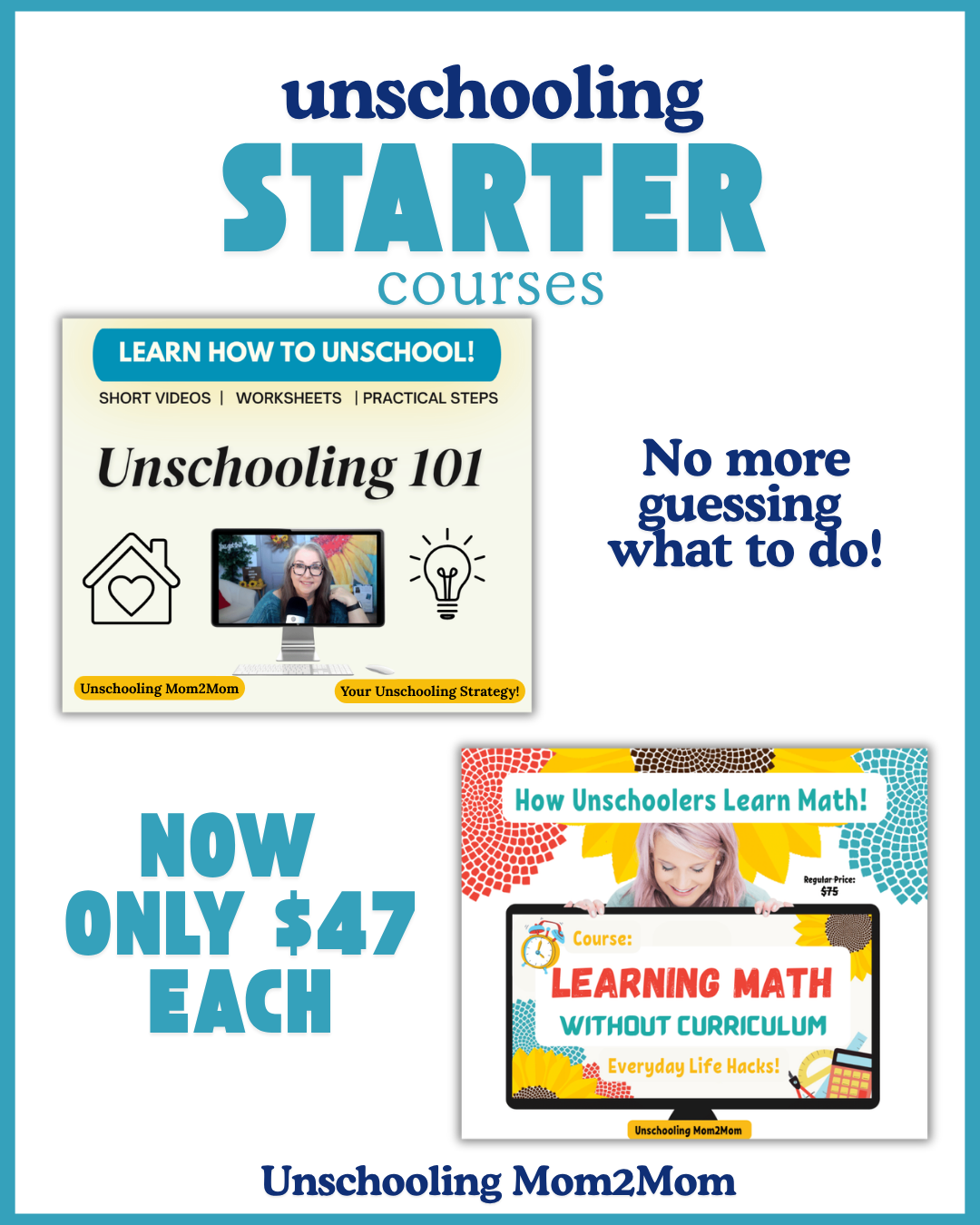
If you’re realizing that this reframing may be the missing puzzle piece for you, I have unschooling courses that can help!
Unschooling 101 and Learning Math Without Curriculum
are video courses available to parents to help you rethink what learning needs to look like.
Unschooling 101 will help you shift away from the school framework and understand how to make unschooling work in everyday life.
Then
Learning Math Without Curriculum takes one of the subjects parents worry about most and shows you what this looks like in practical application.
You don’t need another curriculum. You may simply need help reframing what learning looks like—and some practical ideas for how to support it when it isn’t organized into lessons.
In the meantime, we can keep taking off the blinders a little at a time, widening the lens, and returning to the child who is actually here—not the future child fear keeps asking us to imagine.
Maybe that’s what trust really looks like.
Not knowing exactly how everything will unfold, but paying enough attention to take the next step together.
So. Take a look at those timelines you’re carrying around.
Reach out if you need any help with it.
Happy Unschooling and I’ll see you next time.