
Unschooling Teens & Sleep
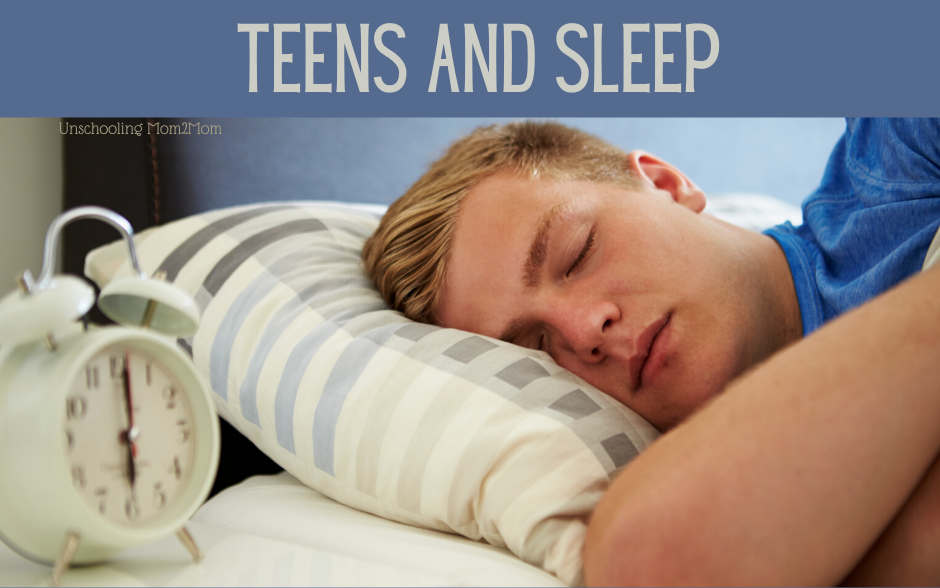
Years ago, your child was up at 6 a.m., peeling eyelids back, ready for you to help him greet the day. But not so with your teen. Maybe you’ve been up puttering around all morning, fixing yourself some lunch when you notice your teen is still snoozing. What the heck is going on here?
It turns out, quite a few things.
We all know that when children reach puberty, their hormones change. What we sometimes don’t know or remember is that these hormones have an effect on a person’s sleep cycle. Nocturnal melatonin production decreases significantly during adolescence. It actually shifts, making the adolescent’s body more awake in the evenings, not feeling ready for an early bedtime, and then leaves them groggy in the mornings with the melatonin still onboard. Add to that, light – artificial or natural – also inhibits the production of melatonin. Teen body clocks, their circadian rhythms, are shifting.
Translation: Teens’ bodies are physically geared to staying up later at night. Because they still need a good nine hours of sleep, that means they’ll need to sleep later in the mornings. Lots of data on this can be found at the National Sleep Foundation .
This certainly doesn’t correlate with a typical high school schedule. Research shows that teens in school settings are basically sleep deprived This sleep deprivation can lead to increased stress, impaired memory, and inhibited creativity. It certainly interferes with learning! And those behaviors that people consider “typical teen difficulties?” They’re worsened if teens are in desperate need of more sleep. They may even be created by their lack of adequate rest! It’s not about power struggles or undermining authority, as some parents fear. It’s something physical happening to their bodies.When parents of teens opt out of school, their families are no longer forced to duplicate high school schedules. Teens can stay up late and then sleep in. This ensures that they get a full night’s sleep to be well rested and ready to explore and learn. A new study by National Jewish Health found that homeschooled teens had a big advantage because of their healthier sleep habits.
When parents ask their children to go to bed earlier so they can all get up earlier, they may be working against nature. It’s not the end of the world to do it, but why set up a problem situation? Why turn it into a power struggle?
Another benefit to parents working with their teen’s natural, inner body rhythm is that some of the best teen-parent conversations happen during those late hours! My teens were often feeling more relaxed and winding down from their day around 11 p.m. Those late night conversations were real treasures, often giving insight into what was happening in their lives – what they were nervous about or looking forward to. They were open to listening to my suggestions or stories about what I’d seen in the past.
When my kids were teens at home, I let them sleep late in the mornings and go to bed at whatever hour they chose. It often looked upside down when compared to the rest of the world’s schedules. Homeschoolers (and “schoolers” – as my kids used to call them) would ask me, “How will they be able to hold down a job, follow a schedule, adhere to expectations, if I never impose any schedules on them as children?”
It’s a non-issue. It would have been like practicing the act of waiting in line. Do we really need to set up an arbitrary practice for this?Don’t we do that at grocery stores, at the post office, at the DMV, at the restaurant… multiple opportunities every day? Or maybe they’d suggest that everyone practice eating or sleeping or walking? Sounds pretty ridiculous, right?
Honestly, when they were younger, I’d think, “Well, they just won’t work a job that conflicts with their natural rhythm. Lots of people work evening and night shifts.” I kind of expected that they’d continue to follow their internal body clocks.
But that’s not what happened.
My teens found jobs they wanted and made their rhythm cooperate. They learned what “a good night’s sleep” felt like, and they wanted it! So if they had to get up early on some mornings, they’d go to bed a little earlier the night before. They’d set their alarm clock, take their showers, and head out the door. It wasn’t long before they were poking their head into my room, waking me briefly to say they were off to their 7 a.m. shift! The naysayers’ predictions just didn’t play out. My teenagers managed just fine.
One summer, my daughter Katie went to stay with her grandmother in Dallas so she could attend a month-long intensive drama program. She got herself up at 5 a.m., checked her email, fixed her own breakfast, showered, got dressed and caught the city bus to go downtown. She was 15. My daughter Alyssa attended cheerleading competitions and had to be completely ready and backstage by 7 a.m. This meant getting ready before 6 a.m.! Two of my teens worked early shifts at Barnes and Noble for several years and never had any problem with being punctual. They took early morning classes in college and had no problems making it on time.
I share all of this to reassure you about your teens and their “wacky” sleep schedules. Parents really have nothing to worry about. Take advantage of those late nights with your teens. Chat with them about life, in the kitchen over nachos – even if it’s midnight! Talk to them about what you’ve read or learned about sleep and body rhythms. No one needs to rehearse getting up early. They will do it when they need to.