
Fun September Homeschool Ideas
Fun September Homeschool Ideas—No Curriculum Needed
What Is Strewing in Homeschooling?
Strewing is bringing interesting ideas, books, videos, materials, or activities into your child’s world and seeing what catches their attention.
You aren’t assigning a lesson or deciding where it must lead. You’re simply offering possibilities and giving curiosity more opportunities to find something interesting.
Fun September Activities for Kids
- Make Rice Krispie treats and experiment with recipes and measurements.
- Celebrate Video Games Day, Batman Day, or Hobbit Day.
- Learn about crabs, rabbits, and their natural habitats.
- Notice the changing daylight around the Autumn Equinox.
- Track sunrise and sunset times, temperatures, or shadows.
- Play with Play-Doh or begin a new creative project.
- Learn a few signs or celebrate Talk Like a Pirate Day.
- Watch a Broadway musical or explore a favorite performer.
These September homeschooling ideas can naturally lead to math, science, reading, geography, history, creativity, and problem-solving—without curriculum, worksheets, or assigned lessons.
Watch or Listen...
Transcript below
Podcast Transcript:
While a lot of homeschooling parents are scrambling to get their kids interested in the curriculum they bought, other families are noticing all the fun things happening in September.
Did you know September has Rice Krispie Treat Day?
Now, in a lot of people’s eyes, Rice Krispie treats might be about as far away from “legitimate learning” as you can get.
But not in an unschooling house.
And not for families who recognize that learning can weave through even the most playful activity.
What matters is the child’s engagement.
When they’re interested, curious, and participating, learning becomes the natural byproduct.
Let me show you what I mean.

I’m Sue Patterson, and this is the Unschooling Mom2Mom podcast. (See past episodes)
After 30 years in the homeschooling and unschooling communities, I’ve learned a lot about what works—and what doesn’t work—when families move away from school.
I bring you these short unschooling pep talks to offer a little reassurance, help you recognize the learning already happening, and make this way of living easier.
If that’s something you need, take a minute to subscribe—whether you’re listening to the podcast or watching on YouTube. That way, we can stay connected.
Now, let’s talk about Rice Krispie treats.
Maybe you mention that Rice Krispie Treat Day is coming up, and your child wants to make some.
They read the recipe. They measure ingredients. They watch marshmallows change as they heat. They estimate whether everything will fit in the pan. They figure out how to cut the finished treats so everyone gets one.
Maybe they wonder who invented Rice Krispie treats or why cereal makes that snapping and popping sound.
Or maybe they dump in the cereal, lick the spoon, eat two squares, and move on.
That’s okay too.
The point isn’t to turn Rice Krispie Treat Day into a lesson.
The point is that when children are engaged in real life, learning naturally weaves through what they’re doing.
Some of it looks like math. Some looks like science. There’s reading, problem-solving, sequencing, cooperation, and independence.
Your child isn’t dividing life into subjects. They’re simply making something they want to eat.
The subject labels are for us.
They help parents who are still learning to see that education doesn’t disappear when we stop using curriculum.
It simply looks different.
Learning Weaves Through the Month
Once you begin to recognize learning this way, the next question is often, “Where do all the ideas come from?”
Because you don’t want to replace curriculum with a new job where you have to manufacture fascinating educational experiences every day.
Fortunately, interesting possibilities are everywhere. They’re in the changing seasons, something happening in your community, a new food at the grocery store—or one of those fun, sometimes silly celebrations you didn’t even know existed.
That’s where strewing comes in.
Strewing is simply bringing possibilities into your child’s world and seeing what catches their attention.
You aren’t assigning it. You aren’t disguising a lesson. And you don’t have to know where it will lead.
Strewing is scattering ideas you can run with.
September alone offers all kinds of possibilities. There are celebrations every single day of the month!
Maybe your child would perk up if they knew about celebrations around desserts!
Or maybe they’d be more interested to know there are Video Games Day, Batman Day, or Hobbit Day this month.
A child who loves animals might not want to miss Crab Fest Day or Rabbit Day.
Each of these daily celebrations can be jumping off places to learn more.
That child interested in crabs or rabbits may encounter animal habitats, adaptations, food chains, geography, life cycles, size, speed, populations, or comparisons between species.
They may watch videos, read facts, draw pictures, build habitats, or tell you everything they’ve discovered while you’re trying to make dinner.
Science is there.
Geography may be there.
They’re building vocabulary as you read more or talk about the topics. They may run into numbers, measurements, graphs, or comparisons.
But you didn’t have to assign a science lesson about crabs.
You mention it, and you see if they’re interested.
The learning weaves its way in because the child is engaged.
That’s the shift.
Instead of asking, “How can I get my child interested in the lesson?” we start with something that interests them and notice where it leads.
You Don’t Have to Know Where It Will Go
This is where unschooling can feel uncomfortable at first.
Curriculum tells you what the child will learn before the activity even begins.
It gives you an objective, a lesson, and usually some way to prove they absorbed it.
Real-life learning doesn’t always announce itself that neatly.
You may mention Rabbit Day without knowing whether your child will watch a funny rabbit video, research different breeds, ask for a pet rabbit, or ignore the idea completely.
You don’t have to know in advance.
Strewing is about bringing interesting possibilities into your child’s world without needing to control what they do with them.
Some ideas go nowhere.
Some lead to a five-minute conversation.
Others open the door to an interest that lasts for weeks, months, or even years.
You’re not planning the outcome.
You’re creating more opportunities for curiosity to bump into something interesting.
September Keeps Offering Possibilities
The Autumn Equinox is this month too.
That gives you a natural reason to pull out the globe or notice how the daylight hours are changing.
Maybe someone asks why the seasons are changing—or why it’s becoming autumn where we live while spring is beginning somewhere else.
Maybe you begin paying attention to sunrise and sunset times.
You might compare temperatures, notice shadows, talk about the Earth’s tilt, or wonder how people in different places mark the changing seasons.
I even recorded a
podcast about Daylight Saving Time last spring.
You could listen to that here and see how many different directions one topic can go.
- History.
- Geography.
- Government.
- Science.
- Math.
- The way people organize time
Learning doesn’t stay inside one subject box because life doesn’t stay inside one subject box.
And you don’t have to follow every possible path.
Maybe your child only notices that it’s getting dark earlier.
That moment of observation is still part of understanding the world.
Making this Easier for Parents
Now, you could search for all these possibilities yourself. But that could easily become one more job for you—and that’s why I created the Strewing Calendar.
When you subscribe, you get the printable monthly calendar filled with these kinds of ideas.
Your family can hang it up, look it over, and circle the possibilities that sound fun.
Then I send you a daily email with links and ideas for exploring that day’s celebration a little further.
You don’t have to search for everything yourself.
You don’t have to plan a lesson.
And you don’t have to use every suggestion I send.
You can open the email, see if anything catches your attention, and share what might appeal to your particular child.
I’ve also included learning objectives for every day of the month.
Those aren’t there because your child needs to see the objective before they’re allowed to enjoy Rice Krispie treats.
They’re there for you.
If you’re still deschooling, those objectives help you practice recognizing the familiar subjects woven through everyday activities.
And if you live somewhere that requires progress reports or proof of learning, you’ll have language that helps you document what your child is doing.
The learning connections are already identified for you—all 30 days of the month.
You can stop wondering, “Does this count?”
You can look at what actually happened and recognize the science, math, language arts, geography, history, creativity, and problem-solving inside it.
It Doesn’t Have to Look Educational
Your children don’t need every day of September filled with educational activities.
They need a life with interesting possibilities.
Maybe this month they make Rice Krispie treats.
Maybe they investigate rabbits, play with Play-Doh, talk like pirates, learn a few signs, watch a Broadway musical, or pull out the globe for the Autumn Equinox
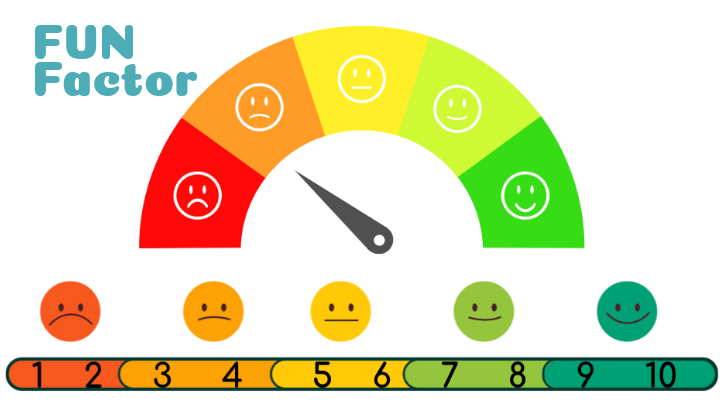
Fun Factor Scale
Some ideas will be a ten on their Fun Factor Scale.
Some may only be a six—but still interesting enough to explore
.
And some won’t appeal to them at all.
That’s fine.
The calendar isn’t there to control their learning.
It gives you easy ways to add more possibilities to the buffet—and then pay attention to what your child chooses.
That’s where the real learning begins.
If you’d like the September Strewing Calendar, the daily links, and all the learning objectives already done for you, I’ll leave the subscription link in the show notes.
The Strewing Calendar is also included in the Creating Confidence Full Community membership. So if you’re looking for more unschooling support, coaching, and connection with other parents, that may be the better option for you.
You don’t need a curriculum to make learning happen.
You need:
an interesting life,
some fun ideas to run with,
and the willingness to notice where your child’s engagement leads.
Learning will weave its way in.
It always does.

Happy Unschooling!
~Sue
Frequently Asked Questions about Strewing:
→ Where can I learn more about Strewing?
RIght here:
What is Strewing? (blogpost)
Strewing Calendar for Homeschooling and Unschooling Parents (video)
→ Does strewing have to be educational?
That's all going to depend on your definition of "educational."
If you're thinking it has to be something that would definitely show up in a classroom, then, no. But if you are starting to see that everything is educational — even topics that appear to be inconsequential — we cannot know if or when your child will build on that.
If we only strew things because we can already identify the academic payoff, strewing can quickly become curriculum in disguise. Something can be worth sharing because it makes your child laugh, sparks a conversation, gives you something enjoyable to do together, or opens one tiny new window into the world.
You don’t have to prove that every possibility was educational. Sometimes where it leads becomes clear later. And sometimes it’s simply fun. That counts too.
→ What if my child isn’t interested in something I strew?
Expect this to happen! The point is to toss a variety of ideas into the path with the goal to learn more about what they like. This will help you have more successes in the future. It's not easy to pull our own ego out of the interactions - that's why it helps to be in an unschooling community! (Creating Confidence Community now has 2 Tiers!)
→ How often should parents introduce new ideas?
TIming depends on your schedule and your family. Casual conversations weave into the days. Suggestions or links can pop up when someone is wandering around looking for something to do.
Having the calendar at the beginning of the month gives your child the flexibility to pick and choose based on their interests. Keeping it in a prominent place allows everyone to notice—or continue thinking about—the different possibilities throughout the month.
If you find something in the link collection that you think they might enjoy, you can always casually mention it or share it with them. Then watch their reaction. Their response will give you so much more information about what interests them and how to approach strewing in the days ahead.
→ How can homeschoolers document learning without curriculum?
Use the daily learning objectives I identify each day for the various celebrations on each month's Strewing Calendar.
It's all done for you!
After your child explores something, you can use those objectives to help describe the science, math, language arts, geography, history, creativity, or problem-solving that actually occurred.
You don’t need to quiz your child or turn the experience into an assignment. Simply document what they did and use the learning objectives to translate it into more familiar educational language.
→ Can strewing work with teenagers?
Absolutely! The difference between younger and older kids has to do with the depth of their engagement. Teens may find a YouTube video on a particular topic that is exactly at their own developmental level for learning, humor, or engagement. We're not stacking blocks over here - we're exploring the world!