Connecting with Your Gamer Teen
No one prepared you for parenting a teen - certainly not in this day and age.
Don't let fears about gaming interfere in your connection with them!
How to Connect with Your Gamer Teen
(Without Pushing Them Away)
When our kids were younger, connection came easily.
We’d go outside and they’d marvel at the clouds, the wind, or a butterfly passing by. We’d snuggle on the couch for stories, laugh at Snapchat filters together, or bond over popsicles and playdates. They lit up when we walked in the room.
But then..they grew up.
Now they shrug when we suggest something.
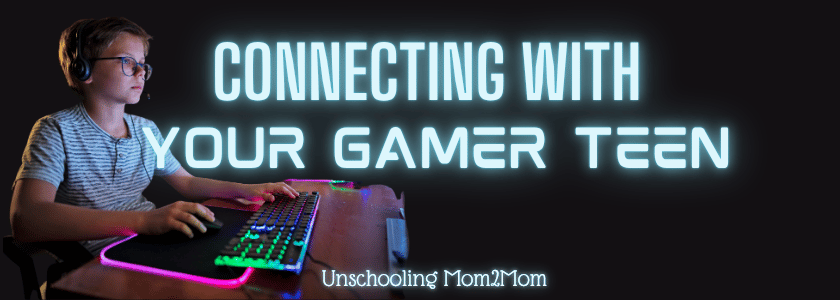
They’re focused on their games.
They might be holed up in their room more than we’d like.
And suddenly, those little everyday moments of connection feel fewer and farther between.
If you’ve found yourself wondering,
“Where did my kid go?”
—or worse—
“Did I lose them?”
You’re not alone.
Let’s talk about what’s actually happening—and how to reconnect in a way that works for them.
Resources for You!

From Close Companions to “Roommate Mode”
One mom on a recent coaching call told me,
"I didn’t sign up to be his roommate."
I knew exactly what she meant.
That feeling of just coexisting—of passing each other in the kitchen and not really being
in each other’s lives anymore.
But here’s the thing:
What if Roommate Mode doesn’t have to be a negative?
What if you reframed it as an invitation to be the best roommate they’ll ever have?
That might look like:
- Respecting their space
- Sharing snacks without a side of judgment
- Being nearby without dominating the conversation
- Offering calm, no-pressure presence
- Checking in without prying
That’s not giving up. That’s growing up—together.
When we release the expectation that connection should look like it did when they were six, we open ourselves to a deeper, more respectful kind of relationship.
Was Curriculum Ever Real Connection?
If you were a traditional homeschooler, you might look back and think,
“But we used to be so connected when we did school together!”
You read aloud, worked through lesson plans, maybe sat at the table side by side doing math or handwriting.
But here’s a gentle question to consider:
Was that
real
connection... or just you feeling productive?
Maybe you felt connected because the day had structure, and your kid was (kind of) cooperating - until they weren't.
But were they feeling bonded to you through that?
Or were they just
waiting for it to be over so they could finally go do what they loved?
Sometimes we confuse compliance with connection.
Now that your teen has more autonomy, they’re showing you what lights them up.
It might not be read-alouds or science kits anymore—it might be
gaming.
That doesn’t mean the connection is gone.
It just means you might have to
meet them where they are now.
Presence Without Pressure
One parent on our weekly group call shared that her autistic teen loves to be in the same room—but doesn’t want to talk.
That kind of presence can be confusing if you’re a talker.
You might think,
"He sat down next to me...maybe he’s ready to chat!"
But not all presence is an invitation to converse.
Sometimes, it’s a need to recalibrate quietly—just being near you without having to
do anything.
If every time your teen enters a room, you immediately launch into questions or advice or chatter…
they’ll start to associate your presence with stress.
And that’s not what you want.
Sometimes the most powerful way to reconnect with your teen is to be there without needing anything in return. No strings. No expectations.
Just quiet love.
Gaming Isn’t a Wall—It’s a Bridge
It’s easy to see gaming as the thing that pulled your teen away.
But what if it could be the thing that brings them back?
You don’t have to play with them (though some do!).
You don’t even have to like the game.
But if you can ask with genuine curiosity—
“What do you love about this game?”
“What’s the hardest level you’ve beaten?”
“Do you ever play with friends?”
—you’re showing them that you’re still interested in who they are becoming.
Not because you want to change them.
But because you care.
You’re Still the Anchor
Your teen still wants connection.
It just looks different now.
Sometimes it’s a shared meme.
Sometimes it’s sitting side-by-side in silence.
Sometimes it’s you asking about their latest game—without judgment or agenda.
The good news?
They’re still watching how you show up.
They still need your steadiness. Your calm. Your care.
So take a breath. Let go of the old image of how connection “should” look.
And lean into the one that’s growing right in front of you.
You’ve got this. And I’m here if you need support.
💛 Sue