Day In the Life: How Unschoolers Learn Math

Unschoolers "Do Math" Without Even Trying!
You might think math only happens in a workbook or classroom, but for unschoolers, it unfolds naturally throughout the day. When kids follow their curiosity and live engaged lives, math is simply part of the landscape—not something set apart.
In school, subjects are separated and labeled so the system can track progress and standardize outcomes. But that’s a structure designed to keep institutions running smoothly—not necessarily to support how real learning happens.
In real life, math doesn’t live in a separate box. It shows up in decisions, projects, conversations, and play.
When parents begin to shift their mindset—to look for the learning instead of trying to impose it—they start to see it’s already there. Math is in the timing, the measuring, the problem-solving, the pattern-spotting. It’s in their kids' real lives, even if there’s not a workbook in sight.

Hour-by-Hour: Unschooler Mathing...
Let’s follow one unschooling teen through a typical day and spot the hidden math as it naturally appears.
8:00 AM – Waking Up & Planning the Morning
- Notices the time on the clock and knows hitting snooze adds 9 more minutes.
- Mentally calculates how much time they have to get ready before leaving.
- Estimates how long breakfast will take to cook so they can eat and still make it to the skate park before the heat.
- Scoops the dog food, using the measuring cup so the proportion is correct for the dog dish.
9:00 AM – Heading to the Skate Park
- Checks the weather app to see when the temperature will peak.
- Estimates how much time they'll have to skate comfortably before it gets too hot.
- Coordinates meet-up time with a friend, figuring in drive time and traffic.
10:00 AM – Math at the Skate Park
- Estimates distances for tricks and runway lengths.
- Times attempts at routines and tracks progress.
- Calculates ramp angles and speed needed for jumps.
- Looks at the grid on the water bottle to see if it needs to be refilled.
- Discusses how shade affects temperature and energy.
11:00 AM – Back Home for Minecraft
- Calculates how many resource blocks are needed to build a house.
- Estimates crop growth time within the game’s environment.
- Converts raw materials (like iron or wood) into usable items using ratios.
12:00 PM – Lunchtime Math
- Halves a sandwich and measures portions of rice or soup.
- Compares serving sizes and nutritional info on labels.
- Divides leftovers for snacks or meals later in the week.
- Find containers that fit amount of food leftover.
1:00 PM – Guerilla Tag (VR)
- Tracks movement and agility scores over time.
- Estimates leap distances and success rates.
- Syncs fitness app to review calories burned and energy used.

2:00 PM – Quick trip to the store
- Estimates the size cart they'll need
- Notices price variations based on quantity purchased - makes price comparisons
- Counts the number of snacks in a box to estimate if it will last the rest of the week.
- Speeds up walking to get into the short checkout line.
- Calculates which lane will be best - who has more in their carts, which checker is training someone, who has coupons.
- Bags groceries by size, weight, temperature.
3:00 PM – Swim & Social Time
- Times how long they can hold their breath underwater.
- Divides toys and games evenly with friends.
- Estimates how much time is left before heading home.
4:00 PM – Managing Money & Tech
- Counts allowance to see if they can afford a new digital item.
- Compares prices on apps and calculates sales tax.
- Converts remaining gift card balances into real-world purchasing power.
5:00 PM – Playing Soccer at the Park
- Tracks goals scored and compares with past games.
- Divides into fair teams and rotates players.
- Estimates how long before sunset and when to head home.
6:00 PM – Helping with Dinner
- Adjusts recipe quantities to match the number of people eating.
- Measures ingredients and calculates serving sizes.
- Estimates how long the meal will take to cook.
- Notices how many chairs are needed at the table.
7:00 PM – Family Time
- Watches a cooking show and converts metric measurements.
- Reviews screen time usage via a device tracker.
- Preps snacks for later gaming sessions, dividing portions evenly.
- Plays a board game with dice, spaces, strategies.
- Plays MarioKart with estimates, scoring, ranks, speed, distance, time.
8:00 PM – Dog Walk
- Notices the speed of the dog's tail wagging - they're ready to go!
- Estimates how far they’ll go and how long it will take.
- Tells friends online when to meet them for evening gaming.
- Tracks steps using a phone app.
- Notices treats are low, halves one to get the dog when they get back.
9:00 PM – Games on Phone or Tablet
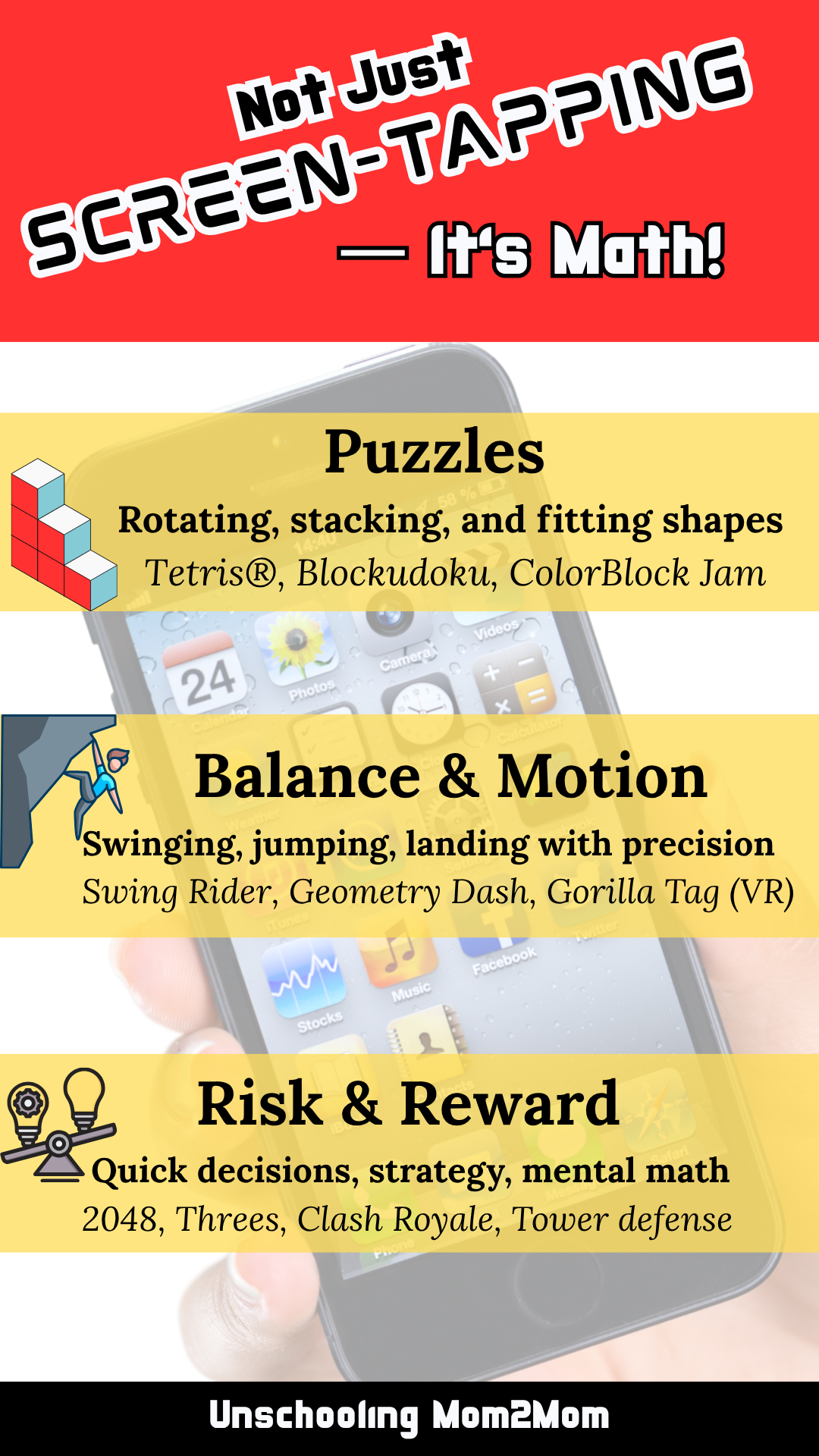
- Puzzles: Rotating/stacking shapes using spatial reasoning on a timer. Estimating geometric angles and alignment for efficient fits.
- Balance & Motion Games: adjusting angles and momentum to land safe jumps, timing swings precisely to stay on course, estimating speed and distance to avoid falling.
- Risk & Reward Strategy Games: Weighing probabilities before making in-game choices, using mental math to make fast decisions under pressure, tracking high scores and adjusts strategy based on results.
10:00 PM – Roblox Time
- Calculates how much in-game currency is needed to buy accessories.
- Estimates how long a game level will take to finish.
- Tracks progress and performance in an obstacle course game.
11:00 PM – Winding Down
- Looks at the clock and plans how much sleep they'll get before morning.
- Calculates how many hours remain until their next commitment.
- Reviews phone battery usage and percent remaining.
- Takes the stairs two-at-a-time on their way to bed.
Math Is Everywhere When You’re Paying Attention
For unschoolers, math doesn’t have to be a chore or a worksheet. It lives in the rhythm of real life—embedded in the choices, projects, and interests of the day. When parents begin to see this, they start to trust that even without a traditional curriculum, their kids are absorbing and applying mathematical thinking all the time.
Want to track the real-life math happening in your home?
Try journaling it for a few days—go on a Math scavenger hunt —you might be surprised by how often it appears!
If you need help with math, so many math resources are waiting for you in the membership.
Plus, you can get all Sue's courses - including Learning Math WITHOUT Curriculum - for 50% off!

Podcast Transcript
Math is the one that gets people.
Sure, we worry about reading… then they learn to read.
We worry about socialization… then they make a few friends and we get connected.
But Math - that’s the biggie.
It’s the one that has layer upon layer of worry. First, it’s little kid math.
Then it’s fractions and geometry.
Then it’s high school level math - and that triggers all kinds of stuff for us, right?
Math feels like the one subject you can’t afford to mess up.
And if you’re trying something different—if you’re not using a curriculum—this is usually the place where the doubt creeps in. All those voices from your past school experiences start telling you to Math has to be learned in a certain order - or you’re off track. Or math is hard and no one likes it, so you just have to make yourself endure - and now… make your kids do the same. In spite of what actual math you’re using in real life.
So instead of countering all these false ideas…
I want to show you something.
Just a regular day.
Let’s follow one teen through a normal day.
No lessons.
No curriculum.
Just life as it’s actually happening.
And we’ll look for the math.
DAY IN THE LIFE
They wake up around 8:00 - if they have to be somewhere. I heard you laughing.
They Hit snooze… knowing that buys them exactly 9 minutes.
Already doing that quick mental calculation—how much time do I really have?
They’re thinking through the morning without writing anything down.
How long will breakfast take?
If I leave by this time, will it still be cool enough at the skate park?
They scoop the dog food—same measuring cup they always use—because they know what “enough” looks like.
By 9:00, they’re heading out.
They check the weather app.
Not for fun—
they’re trying to figure out when the temperature is going to spike.
How long do I have before it’s miserable out there?
They text a friend—
“Meet at 9:30?”
But that includes drive time, getting ready, whether the other person is actually on time…
There’s a lot of estimation happening before the day even really starts.
At the skate park—
They’re not thinking, “I’m doing math.”
But they’re adjusting distances for tricks.
Figuring out how much runway they need.
How fast they need to go to land something clean.
They try something, miss it, adjust.
Try again.
That’s data.
That’s iteration.
That’s math.
Later, back home—Minecraft.
Now it’s resource management.
How many blocks do I need?
How long will this take to build?
What’s the ratio to turn raw materials into something usable?They’re planning, converting, estimating…
inside something they actually care about.
Lunchtime—
Splitting food.
Portioning leftovers.
Looking at labels.
Nothing dramatic.
But it’s there.
Afternoon—VR games, quick trip to the store, swimming, hanging out.
They’re comparing prices without calling it that.
Choosing the shortest checkout line based on what they see in people’s carts.
Dividing things evenly with friends.
Timing how long they can stay before heading home.
Evening—
Helping with dinner.
Adjusting a recipe.
“How much do we need for this many people?”
Making sure the chairs haven’t been moved to another room, so there’s enough.
Later, gaming again—
Tracking scores, timing levels, estimating how long something will take to complete.
Looking at their money online - do they have enough to get the new game. Is it on sale anywhere?
And then winding down—
Looking at the clock.
Figuring out how much sleep they’ll get.
Planning tomorrow without even thinking of it as planning.
So yes…
Math is there.
All day.
In decisions, timing, estimating, adjusting, comparing.
It’s not separate.
It’s not labeled.
It’s just… part of how they move through their day.
And reading a list like this? If you look at this all laid out at the blogpost,
It usually brings a sense of relief.
You can see it.
You can point to it.
And … I want that for you.
But here’s what I’ve seen over and over again—
That relief doesn’t last.
THE SPIRAL
A few days go by…
Your kid has a slower week.
Or they’re on tablet more than usual.
Or nothing looks as obvious as it did in a list like this.
And suddenly you’re right back in your head again.
Wondering if you’re missing something.
Wondering if this is enough.
Wondering what people would think if they saw how it really is over at your house.
Wondering why what you envisioned isn’t happening.
And that’s usually when people start looking for something more structured.
Something they can point to.
Something that feels a little more solid.
A little more… acceptable. Remember, this is when those old voices tap innto all that parent Fear you have. We all have it. Especially if w’re isolated and we don’t realized We all have it.
That’s the spiral I want to interrupt.
STEP 1
Yes—start by noticing.
That’s step one.
And it’s a big one.
Honestly, it might be the hardest one.
You know how they talk about inertia—how that first step takes the most effort, and then things start to build a little momentum?
That’s what this is.
You start to see it here and there…
and then a little more…
and then it starts COMING IN A LITTLE faster.
STEP 2
But step two?
That’s different.
That’s seeing it…
and believing it.
Even when your day doesn’t look like this.
Even when things shift a little.
Or a lot.
Because they will.
Your life isn’t going to look like mine.
Why would it?
Different kids.
Different rhythms.
Different interests.
Different everything.
SEEING A VARIETY OF EXAMPLES
And I think this is the part I like most about the membership group.
It’s not about finding the way to do this.
It’s about seeing it done a lot of different ways.
I remember when I first started out—
I picked the brains of as many people as I could.
And I’d listen and think,
“Okay… I like some of what they’re saying…”
“…but the rest?
Uhhh… no.”
And that didn’t hurt anything.
It didn’t confuse me.
It actually helped.
Because I was starting to figure out what fit for me. As I was unpacking all the things I was carrying with me about learning, and school and kids and parenting.
Actually…
Some of the things I was so sure I’d never do…
those are exactly the things I ended up doing a few years later.
And hearing all those different ways people approached this—
that’s what helped me widen my view of what’s actually possible.
Because when you can see it in a variety of ways…
you start to recognize your own version when it shows up.
And that’s the part that builds real confidence.
Not just seeing math in a list like this…
but seeing it in your life,
in your version, with your crafty kid or your kid who is a gamer…
and trusting that it counts.
So yes—start with noticing.
Let that be step one.
And if you want help getting to that next step—not just noticing the math,
but actually learning how to recognize it in your own real, everyday life…and trust that it counts—
that’s exactly what I built the math course and the membership around.
Not adding more to your plate…
but helping you see what’s already there,
and feel more grounded in it,
even when your days don’t look like this one.
If math is the piece you can’t quite let go of—
that’s exactly what I built the math course around.
Not just examples like this…
but helping you recognize it in real time,
connect it to actual skills,
and stop questioning it every time the day looks a little different.
And inside the membership—
you’re not trying to figure that out alone.
You’re hearing from other parents who had that same sticking point.
“I like this… except for math.”
And over time, through real conversations, you start to sort out what actually matters—
for your kid,
your home,
your situation.
No dogma.
Just people figuring it out together.
So if you read through something like this and think—
“Okay… I see it. But I don’t know if I trust it yet.”
That’s completely normal.
That’s where most people are.
If you want help with that piece—
I’ll leave the links below.
And if nothing else—just start noticing.
Just a little more than you did before.
Happy Unschooling!